〒 Search

Wednesday, March 15, 2006

Peppermint Candy


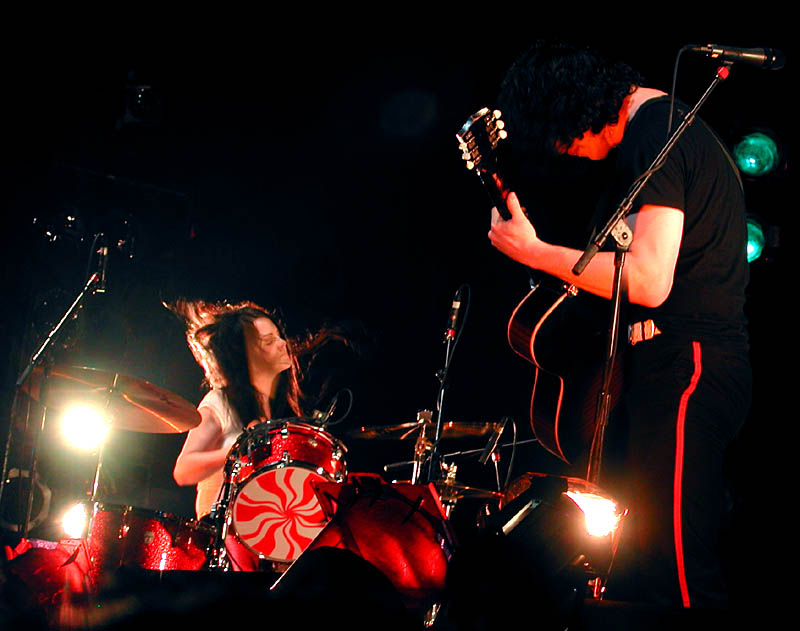
Back in January, I read in the entertainment section of the Daily Yomiuri, an announcement that the White Stripes were to perform in Osaka! I was jacked. I immediately picked up my mobile and sent a text to the wifey, asking her to call Zepp Osaka, the venue hosting the show. When she called, they informed her that the show had been postponed and that a reschedule had not yet been arranged. “Bummer,” I thought but, eventually, expected another date would be set and it was.

A few weeks ago, I was sitting at my desk at school, flipping through the newspaper and learned they rescheduled the show for the 10th of March, last Thursday. Yes! Tsugumi called Zepp again and they told her how to get hold of a pair of tickets. The process was relatively easy- only because we live near a Lawson convenience store- they’re everywhere around where we live. All we had to do was go to an automated machine, not unlike an ATM, punch in a code, and make our selection. It then spit out a slip of paper to be presented to the cashier, who printed and issued us the tickets. Not at all as easy as being able to buy online- Japan hasn’t really caught on to that yet, probably because credit cards are not nearly as common as they are in the States.

The show nearly sold out by the time we secured our spot. Neither of us had been to Zepp and didn’t have a clue what the format would be like. We were able to select our choice, general or reserved, both at for same cost- a measly $65! Okay, yes, crazy price but everything costs double in this country. The main reason we wanted to see the White Stripes here is the rep Japan rock concert scenes have: great acoustics and mellow crowds, (we’re not into the mosh thing- gave that up in high school).

The doors were scheduled to open at 6pm and we arrived about 5:15. It was freezing outside and not knowing what sort of accommodations to expect, we dressed light. There were a few vendors selling overpriced French fries and takoyaki, octopus balls- pass. They had a nice lounge but the smoke was so thick it just about made our eyes water. We opted to wonder over to a wine museum to use the washrooms. I bought a bottle of water from a vending machine, knowing they would be way over priced once we got inside the concert house.

We made our way back to the entry of Zepp, expecting a line; nope. A guy yelling through a loudspeaker was calling out ticket sections, one at a time. I didn’t understand the point of not allowing a line to form but, whatever- we were just happy it didn’t rain. Tsugumi told me that they were calling something out about having an extra $5 ready. “For what?” I asked. Turns out, they charge a beverage fee at the door. I told the woman at the entrance, I didn’t need one but she said it didn’t matter. Lame. I gave her the five spot and she handed me a token I used to exchange for another bottle of $1 bottle of water, though this one was marked up 500%. (Needless to mention my irritation, though not the fault of the band.) As if $65 a ticket wasn’t enough!

We went upstairs to the reserved section and were elated at seeing a non-smoking sign on the door. About the only non-smoking place in Kansai one can find is Starbucks, so I was really relieved. Our seats were just right of center and only three rows back. The floor was about the size of an infield, the stage being less than fifty yards in front of us. We couldn’t have asked for better seats! I was expecting a much larger space but this one was really small; the reserve section was only about seven rows deep and fifty across. Even better, seats on either side of us remained vacant for the whole show.

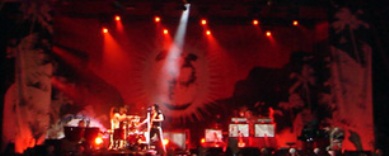
The set display was decked in back, red, and white designs, with a white, pulsating apple in the center- not unlike what is featured on the band’s website.
There were three or four vintage guitars, including 1964 JB Hutto Montgomery Airlines, a Harmony Rocket, a 1970's Crestwood Astral II, and a mandolin resembling something Whitey might play on Leave it to Beaver. Also present were a grand piano, some kind of keyboard that I don’t recall ever seeing before, and a marimba. There was the standard drum set along with two large timpani. Having never seen them live before, I wondered how they would pull it off, being a duo with no stand-ins.

They started the set with the hard edged When I Hear My Name, wasting no time in getting the audience moving. Sure enough, following his opening riffs, Jack quickly sat down, turned down the dial on his '64 JB Hutto to zero, and began playing the piano. It was excellent. Throughout the show, he was running between the piano, key board and drum kit with impressive precision. From time-to-time, men dresses in black vintage suits and derby hats, looking like twin Chaplins or low-ranking bootleggers working for Al Capone, jumped onto stage to untangle wires or replace a toppled mic stand. The show was a testimony that rock still is far from disappearing from the scene- if anything, indy bands like the White Stripes and the Black Keys (another two-person act) have demonstrated how strong back to basic rock and roll still is.

Besides the actual performance, I was also impressed by their set list, which included a wide selection of tracks from all five albums, unlike a lot of groups who stick only to the most requested or most recent songs. The crowd in the reserved section was a little too reserved for me; no one stood up and nobody really applauded until the end- not even during the encore, besides the two of us, that is. The floor was more wild- probably due to the high number of drunken gaijin in the crowd. I would have liked to have jumped around a little bit but not for the entire show. Watching salary men, dressed in suits and ties, packing briefcases, and apparent middle aged housewives showing up and taking their seats- many of whom came solo, made for interesting people watching. That’s one thing that’s pretty cool here; it’s not uncommon to see people in their 60s and 70s standing around watching a punk show at a park, whereas back home, it’s a more than rare sight- unless one takes into consideration the Stones.

After the final track, they expressed their thanks and said it was the last show of the tour. We were really happy to have made it. I don’t know when I’ll ever have the opportunity to see Meg and Jack White in this kind of setting again but if I do, I’ll certainly take it.

Monday, February 27, 2006

Black Coffee Blues


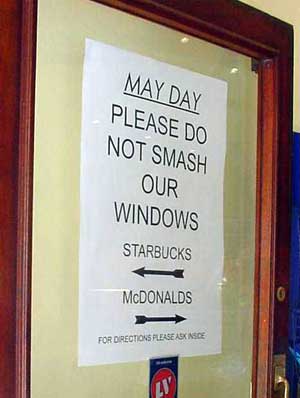
Being a Seattleite, the label of “coffee snob” is already implied. Home of Starbucks, Seattle’s Best, and Tully’s, all easily found throughout Japan, Seattle’s reputation for coffee preceeds itself- in Japan, anyway. To the rest of the world, these coffee giants represent McCoffee- a cheap rip-off from the coffee shops of old, at least as far as good quality taste is concerned. Sadly, these shops are the only place I can readily find a decent shot of espresso, topped with a proper dollop of foam. Upon my arrival in Japan, I tried to avoid these places in hopes of supporting local establishments. Too many times, I got burned, leaving with a soured tongue.

A year or so ago, one of my former colleagues treated me to a mocha at Excelsior Café, a Starbucks wannabe. The mocha was like something I’d expect from a vending machine and though the smokers were separated by the floor above, the stench nonetheless lingered in the air. I then found a little shop near my house- the coffee was so weak it couldn’t even stain the whitest of white silks. The only thing that might discolor fine fabrics in this place were the stale nicotine clouds that permeated the place. Then I found Nishimura’s Coffee, a café decorated in a typical Victorian fashion with dainty tea cups and employees dressed in uniforms fit for a scene of Anne of Green Gables. The waiter politely offered me a table and handed me an English menu. Cappuccino: $6. 'Expensive but...okay, I’ll give it a shot,' I thought to myself. I indicated my choice to the server and he returned a short time later, carrying an eight ounce tea cup of what seemed like brewed Folgers’s, topped with whipped cream. A cappuccino Japanese style? I’m not sure. I choked it down, not wanting to completely waste six bucks. I began reading, Islam and Ecology, but was soon engulfed with secondhand smoke again, prompting my exit.

I reached my breaking point. I gave up. I became a coffee whore. An outspoken critic of Starbucks and their policy of targeting of ma and pa shops, I allowed myself to be sucked into the only hope of enjoying a drinkable cup of joe in a smoke-free environment. I was pleasantly surprised when I entered that all too accustomed space, painted in earthy tones of mocha, and forest green, dotted with quaint maroon colored tables, both because of the familiarity I established with it in my uni days and due to the warm welcome I received from the staff behind the counter. When the barista called out my tall soy cap, I was elated to find a near perfect silky dollop of foam floating on the surface of a double espresso, rising above the rim of a ceramic cup (granted, the shot was left sitting while the foam was being prepared, resulting in reduced crème and the extra hint of flavor it once produced, not to mention having to pay an extra $.50 for the second shot, normally standard in a tall size).

Ahhhh…. the closest thing to quality coffee I had experienced in months. Incidentally, when I visited LA, I stopped into a Starbucks to order my usual. I had to interrupt a conversation between the employees before they even acknowledged my presence. If that wasn’t enough, not only was the shot dead, the foam resembled soap suds left over from washing dirty dishes. It became immediately clear that I wasn’t in Japan anymore.

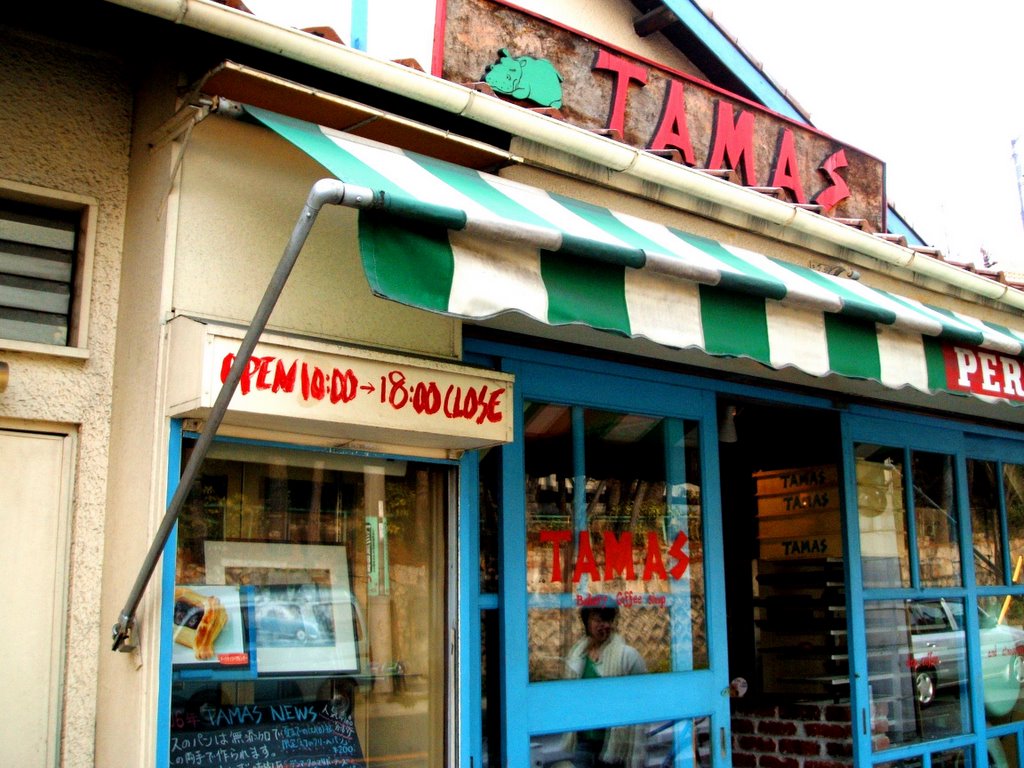
Recently, while on one of our weekend biking excursions, Tsugumi and I stumbled on Tamas, a family owned rustic bakery. Japan is full of French style bakeries but artisan breads are few and far between nor have I yet to come across any sprouted loaves. Tamas not only has artisan breads, they have a great assortment of rolls and pastries. Inside the little blue framed storefront is a cozy space with a street level entrance, displaying fresh baked breads. The smell of wholegrain bread is reminiscent of my childhood; I can recall as though it were yesterday when Vikki, my babysitter, removed her scrumptious, homemade golden loaves from the oven. There’s nothing more pleasant than recalling that buttery aroma, floating in the kitchen and the anticipation of spreading homemade raspberry jam over a warm slice.

Tamas is the kind of place that brings back those childhood memories. This weekend, we returned to relive that experience. We ordered a dark cherry pastry, a folded croissant, along with a raisin role, served hot, a dap of apple butter on the side. Mmmm.
They don’t sell their customers on an array of coffee choices, however; instead they simply offer great drip coffees. Better to do it right than not and try to pass it off as the real thing. They also offer a lunch menu which includes a mouth watering basil, mozzarella, and tomato sandwich, served on… yes, fresh baked bread. We’ve never eaten lunch there but having seen it, there’s no denying the satisfaction of the person who did.

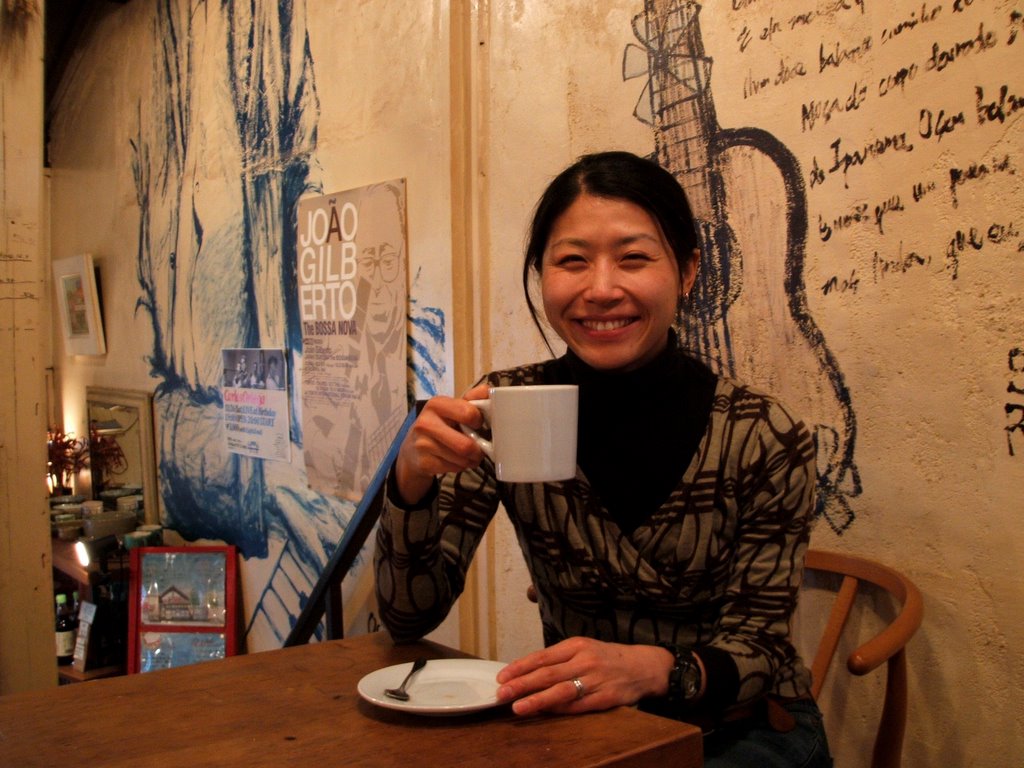
Finding Tamas was a gem. It’s the ideal place to unwind, enjoy great breads, and quality organic coffee. The charming atmosphere of a family run café while thumbing through Tolstoy's War and Peace, while jazz sounds hum in the background, is something I’ve long missed since leaving the Seattle coffee scene behind. Everything found at Tamas comes naturally to the family who makes it happen; homemade breads and pastries, music selected by the people who play it (rather than a pre-programmed list from a corporate office somewhere), authentic murals, painted by local artists (as opposed to the trendy wallpaper pasted to the walls), and family hospitality that just comes with the package, not requiring the clientele to clear their throats in order to be noticed. In short, the experience is an authentic one, unlike the manufactured ambiance of the green and white Siren.

On the weekends, they also sell fresh, organic produce at a reasonable price on the sidewalk out front. Unfortunately, we waited until after we finished our visit to browse the new harvest, which by that time had been pretty well picked over. We bought what we could, stuffing the greens into a backpack, and made our way back over the hill to our flat where we cooked up a big pot of nabe, Japanese stew- the perfect conclusion to a late winter afternoon.

For locals who happen to be reading this, Tamas is located in Ashiya, just up from Ikari Super, a ways north of the Hankyu line, in the Higashiyama-cho neighborhood, at the base of the mountains.

Friday, February 24, 2006

The Little Sicily of Mondoyakujin


Last year, one of my former colleagues recommended an Italian restaurant, only a short bike ride from our flat. We ventured there on a few occasions during the summer but they were always closed. I was worried they had shut down. One day while we were in the vicinity of Mondoyakujin, we followed the sweet scent of simmering tomatoes and fresh oregano to the entrance of La Lanterna. “Alas! It’s open!” we expressed with delightful anticipation. As we ventured inside, we came into a dimly lit space, housing a bar and six or eight stools against the triangular 8 x 12 kitchen (considerably narrower at the end with the cash register), along with a few tables situated opposite the entrance. We managed to squeeze into a tiny space at the bar.

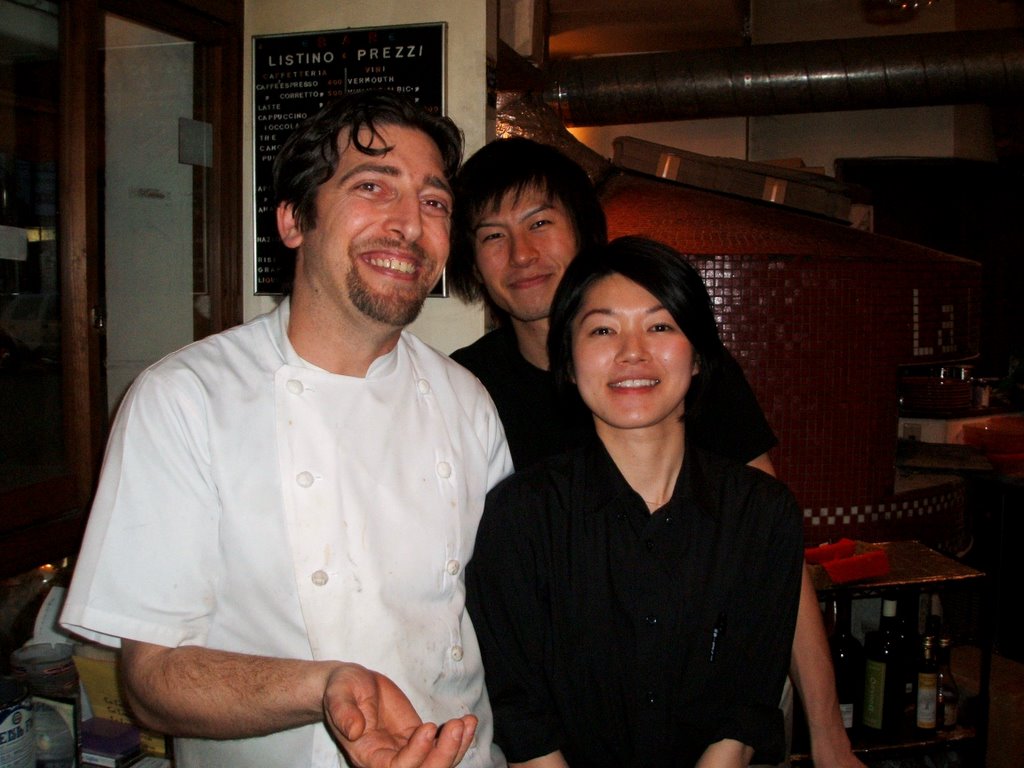
The guys behind the counter were both Sicilian- a hopeful site. The menu features a wide selection of pasta and pizza at typical Japanese prices, $10-$20 a plate. Tsugumi ordered a pasta dish swimming in fresh stewed tomatoes and herbs while I opted for the pizza margarita. The pasta was perfect- served aldente in a light fragrant sauce. The pizza was no less incredible, baked in a large wood fired oven, producing a soft, bubbly crust. We followed it up with espresso and a slice of rich, handmade tiramisu. It’s not everyday that we find Italian food as authentic as this. The only other time I experienced anything similar was in New York’s Little Italy.

Over the weekend, we decided to make our way back there again. We found our place at the bar, this time they were just opening for dinner, the soccer game playing on the television lodged in the corner, near the ceiling above. We were the first arrivals of the evening. Tsugumi decided on the pasta formaggio; I chose the Sicilian pizza. The owner, Salvatore Maggio, is a really friendly guy whose command of Japanese outdoes his English ability. He’s been in Japan for six years and plans to open another spot in Tokyo. He said he imports his ingredients from Italy himself- one would almost have to if they wanted to turn a profit. He also owns a restaurant back home. I don’t know if we’ll ever make it there- for now La Lanterna serves as our imaginary portal into Sicily.

Wednesday, February 01, 2006

Homage to Hiroshima: Day Two, Miyajima


Midway through our memorial visit to Hiroshima, we ventured out on a much needed one-day excursion to Miyajima, located about an hour beyond the city by train. We hopped aboard one of the many streetcars around eleven am, en route to the nearest train station. Unlike many of the subways, trains, and busses I’ve taken, which typically seem fairly new, the streetcars looked as though they had been in operation since the city’s post-war reconstruction. Thick, riveted, ironclad exteriors, nicely painted and very clean inside, the cars rumbled down the tracks laid down middle of the street. Glancing below at the very large slabs of chiseled granite used to house the tracks, I wouldn’t be at all surprised to learn that they were the originals put emplace a century ago. Had the cars not been weighed down by their heavy frames, it would seem as though they’d be doomed to derailing as they leaned from side to side, noisily down the track, reminiscent of the trolleys that screech along the streets of San Francisco.

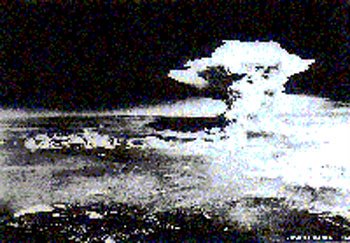
As we made our way down the track, I caught my fist glimpse of the Atomic Bomb Dome, a visible skeleton that brings to mind all the souls that were doomed there sixty years before. An eerie silence enveloped my psyche as we passed by, despite business carrying on as usual around me. I really wasn’t ready to see it yet. We passed over the river, along the reconstructed bridge that was the intended as the target of the bomb, which didn’t actually land but detonated 600 meters above to ensure the utmost devastation.

Creaking down the road, we were soon out of the city, traveling on much smoother rails with views of the mountainside and several small orchards to the west with the bay to the east. The day was cold and windy with the sun breaking through the clouds from time-to-time. We disembarked at the ferry station and browsed around the gift shop- nothing special though. As in America, if you been to one, you’ve been to a thousand. Vendors were attempting to entice passersby with samples of octopus tentacles on a stick, similar to corndogs, I guess, which I politely declined.

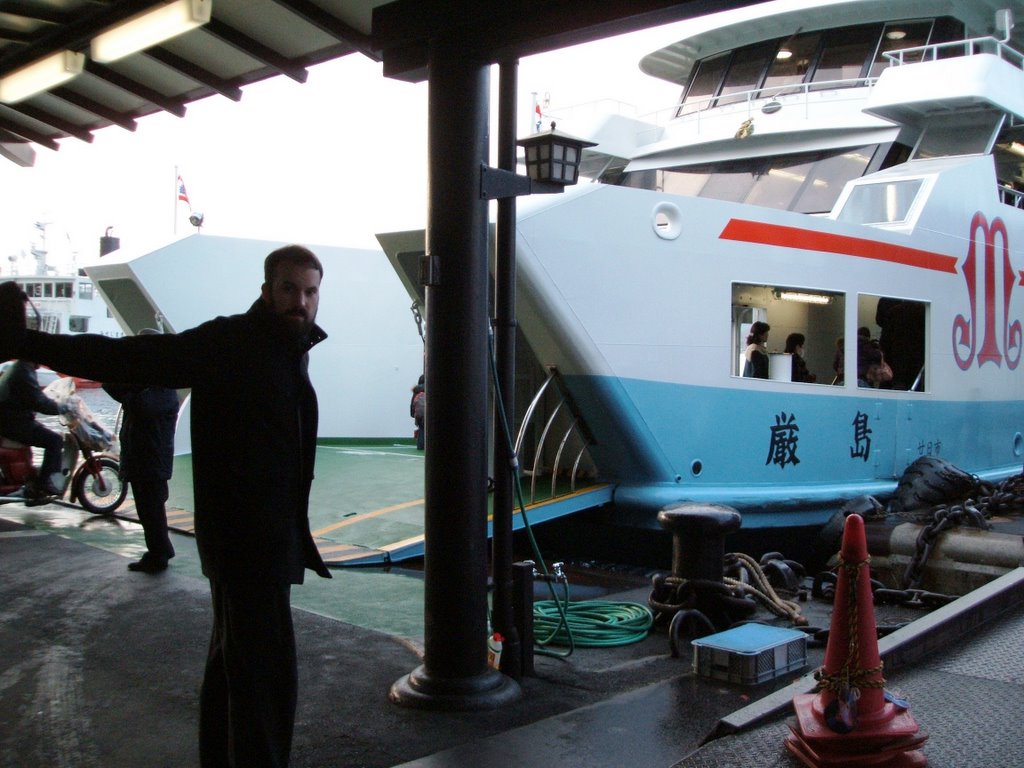
The ferryboat arrived, slightly surprising me by its small size. It may have been able to hold six cars or so but was nothing compared to the ones I used to take across Puget Sound. Not surprisingly, the same number of people were onboard this one as the ones in Seattle. Occasionally, I’m still amused by the miniature versions of things I’m used to back home, i.e., tiny vacuums, kitchen appliances, itsy-mini vans, and garbage trucks not much bigger than the Lincoln Navigator. That’s not to say everything in Japan is small, however. In fact, sometimes the size ratio of trucks to cars, barreling down the road, through red lights and while alternating between slamming on the breaks and slamming the accelerator, can be enough to dissuade anyone from obtaining an international driver’s license.

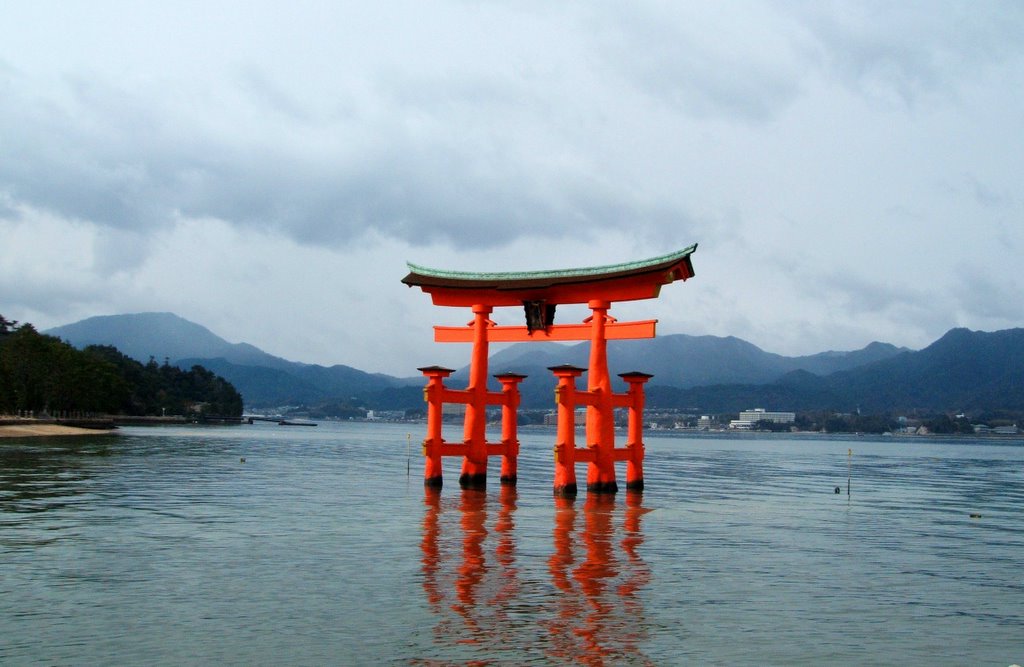
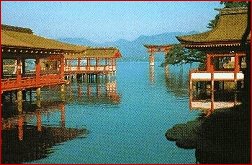
We approached the Itsukushima Island, with the blazing orange gate in the foreground- a spectacular site. As with all Shinto shrines, the gate signals the primary entry, only this one, as well as the shrine itself, was built over the bay so when the tide comes in, it appears as though floating above the sea. The motivation to build it in such as way is unclear; some speculate it was built to honor the goddess of the sea while others have guessed that it represents the Buddhist belief that the soul crosses into the afterlife by boat. Whatever the case, it is a beautiful structure. Due to its unique design and significant age of nearly 1400 years, it is designated as a World Heritage Site. We decided to forego the tour and avoid the crowds, instead viewing it from afar.

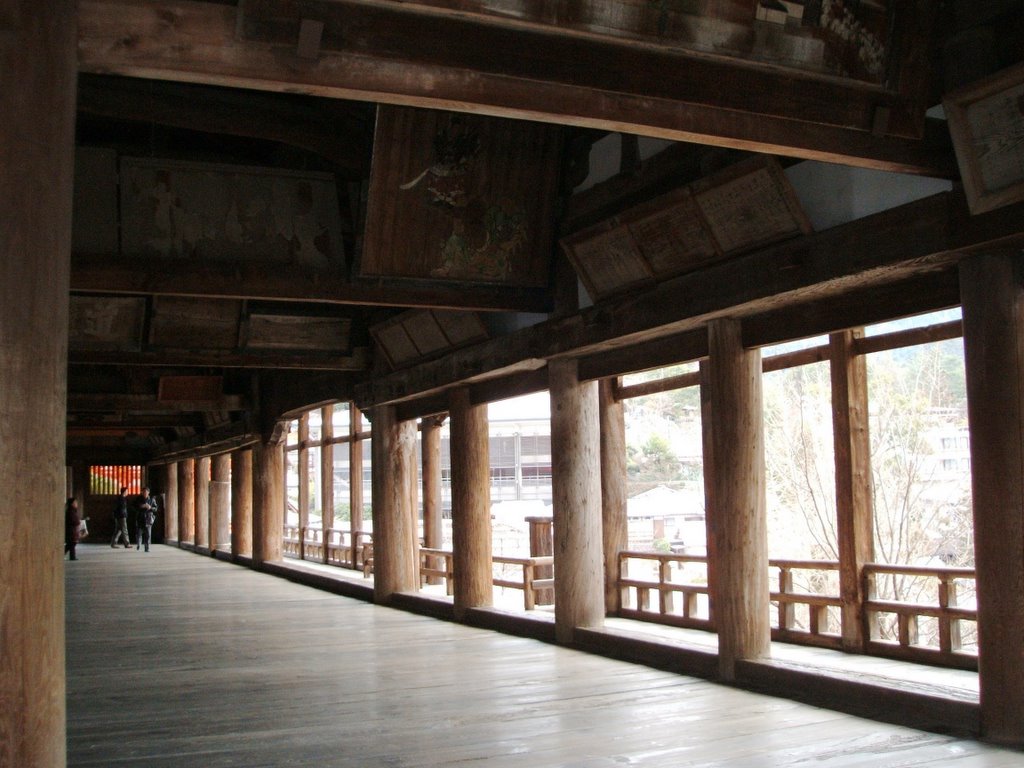
On the hillside above, sits Senjokaku, known as shrine of “1000 mats” due to the great number of tatami that it would take to cover the floors. Built around the same time as Itsukishima Shrine, it was never actually completed. Inside the dimness were a great number of paintings depicting religious scenes, brushed on slabs of wood. Numerous wooden rice spatulas, some of which were as long as a dining room table, others used as canvasses, were displayed, apparently representative of one of the many Shinto gods. My grandparents used to have immaculately painted statutes of this and other Shinto gods displayed in the china cabinet; they have since been handed down to my Auntie.

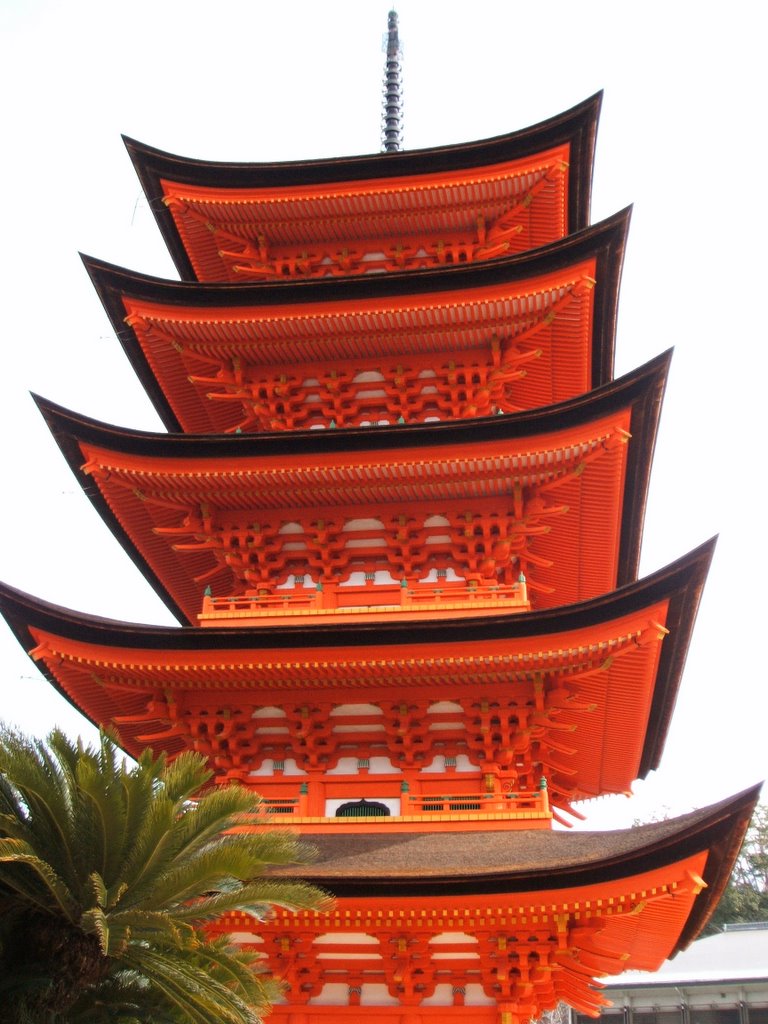
Next to Senjokaku is a five story pagoda, brilliantly painted in bright fiery orange over white panels. I’m guessing the age of the pagoda is similar to the shrines. Modeled after Chinese designs, it rests atop the hill as if it were a crown. Though we were not able to access the inside, it supposedly contains well preserved paintings of natural scenes along with dragons and phoenixes. Originally, there were religious images displayed on the outer pillars but have since been relocated after syncretizing Buddhism and Shintoism became forbidden.

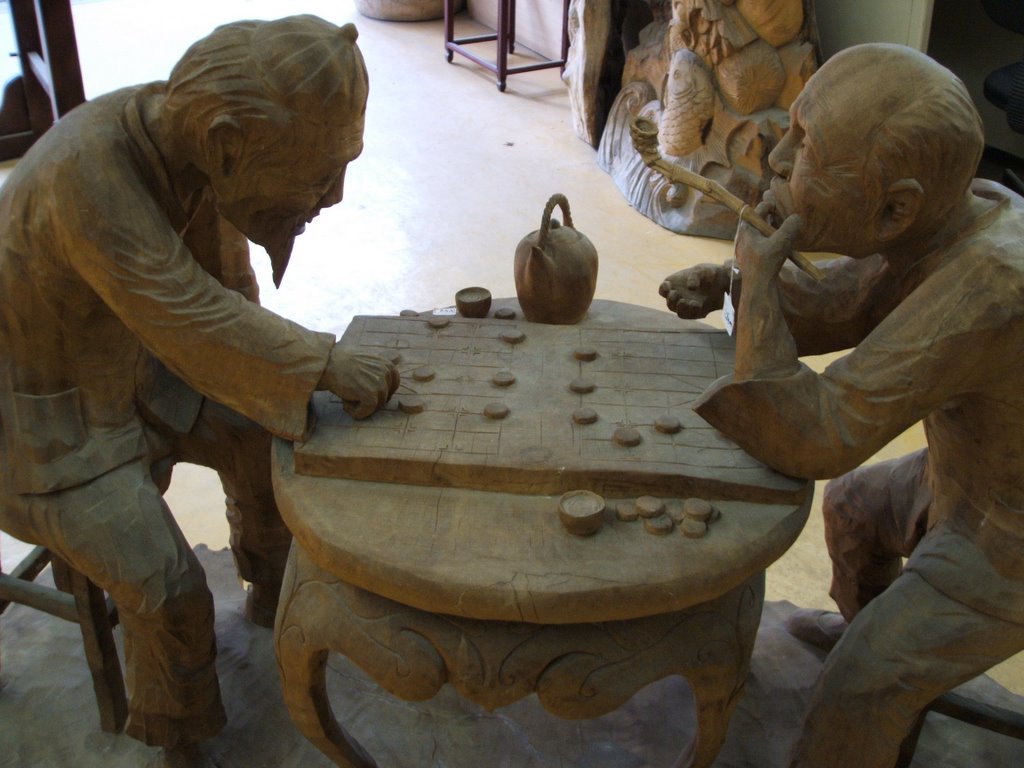
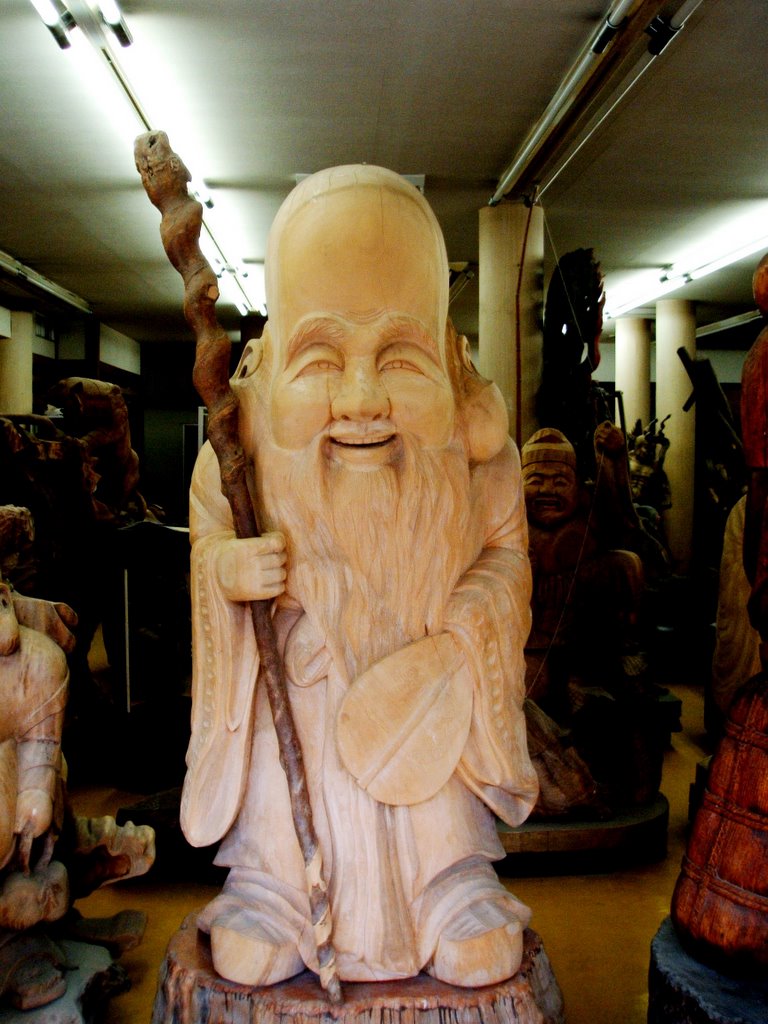
We then walked down to the village and browsed around the shops. We came across some amazing traditional wooden carvings, some being larger than life, with intricate depictions of Buddhist themes. In a few of the shops there were no staff present- not that anyone could easily walk off the island with an 8 foot Buddha hoisted over their shoulder; it was just out of the ordinary. We did manage to go into one shop that was staffed where I left with a little hand drum for my godson, Zayne.

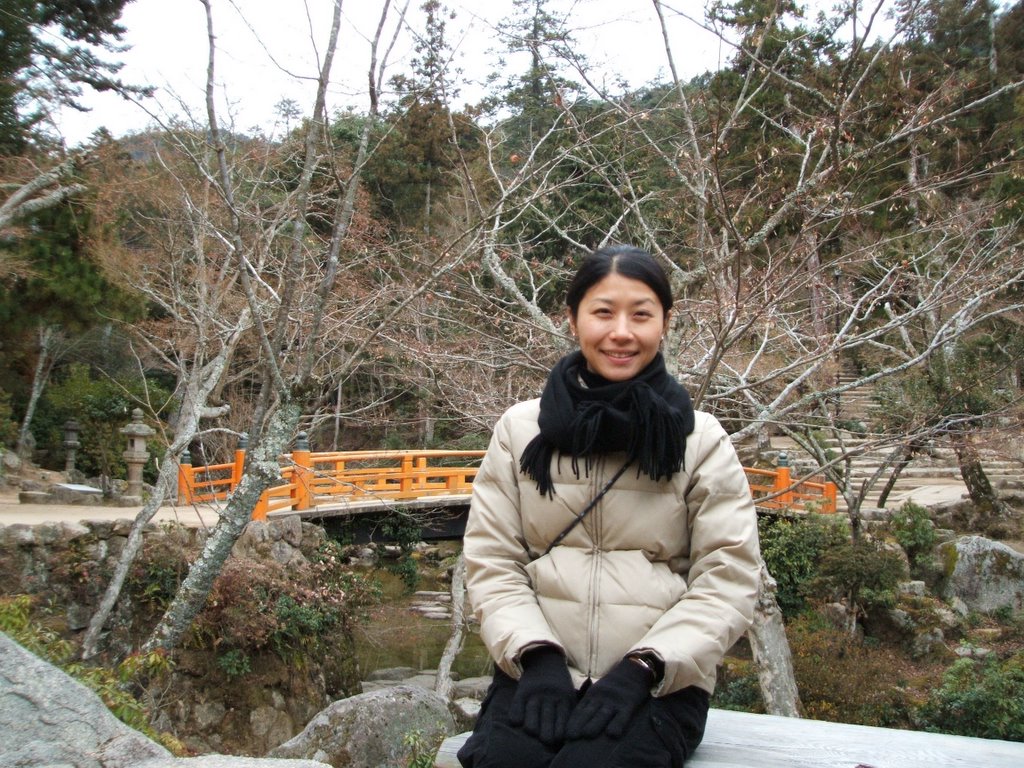
Because the island is scared, there is a prohibition against dislodging rocks (perhaps selectively), thereby protecting the island from becom- ing developed thus, preserving its natural beauty. Beyond the shops is Momijidani Park, a quiet and peaceful place to enjoy creation. There are several small waterfalls with bridges connecting paths to the gondola at the foot of the mountains that leads to the top of the mountain.

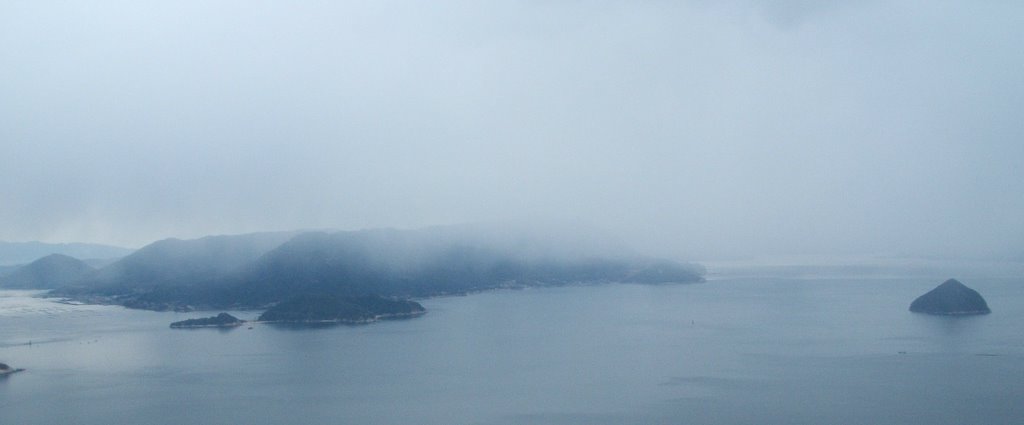
As the ropeway crept in elevation, we could see the entire inlet in the distance, and snow slowly began to fall. The ride to the top took around twenty minutes. When we arrived, there were large packs of monkeys huddled together, trying to keep warm and dear moseying at a comfortable distance nearby. Signs were posted, requesting people not to feed the animals but to keep them wild, which I think were adhered to by the way they distanced themselves from the tourists (a good thing, in my opinion). Few people ventured up there that day, a nice change from the typically claustrophobic popular destinations. From the top, we could see for miles. It was a spectacular view- the best I’ve seen yet.

We made our way back down the mountain shortly after taking in the view from above. On the way back to the ferry, we stopped in the village and had lunch. The streets were more populated and not unlike most tourist areas I’ve visited anywhere else. The main attraction was fresh oysters, cooked over open flame grills and served with lemon. I don’t know that I’d ever tried one prior, but I decided to indulge and was pleasantly surprised. I don’t think I’d be up to eating them any other way. Afterward we made our way back to across the bay only this time, we happened to arrive at the terminal just in time to hop aboard a brand spanking new train providing for a smooth ride back into the city.

Hiroshima should be obligatory for the itinerary of every American who visits Japan. That stated, I highly recommend that those doing so include an afternoon in Miyajima, if for nothing else than to attain some solitude.

Homage to Hiroshima: Day One


In the last days of my winter vacation, Tsugumi and I made our belated trip to the city of Hiroshima. As an American, it was of the utmost to me importance that I make this trip. The timing of our arrival intentionally coincided with the holidays which lend themselves to family time and traditions, both being very important to me; the later I am just now beginning to establish. Despite my personal assessment of Christmas (see my previous entry, So this is Christmas), the last few weeks of the year, especially in the bitterly cold regions of the planet, are ideal for family togetherness and giving to those less fortunate; faith based teachings blend nicely into the atmosphere. This year’s obvious teachings of choice were centered on the importance of peace and reconciliation.

Having studied WWII in university, I arrived to Hiroshima in a mixed emotional state. Each step nearing the city combined racing images of everyday living with nuclear holocaust. As I gazed out the window of the Shinkansen, speeding overhead of neighborhoods and business centers, I couldn’t stop pondering over what the scene must have resembled sixty years ago, less than six months after world stood still, having witnessed the instantaneous incineration of a modern city. A short time later, taking in the view from the streetcar, en route from the station to our hotel, a few miles beyond, was not unlike any other: traffic congestion in the streets and the bustling on the sidewalks, though noticeably less so than those of Osaka. We soon arrived, checked our bags and were on our way.

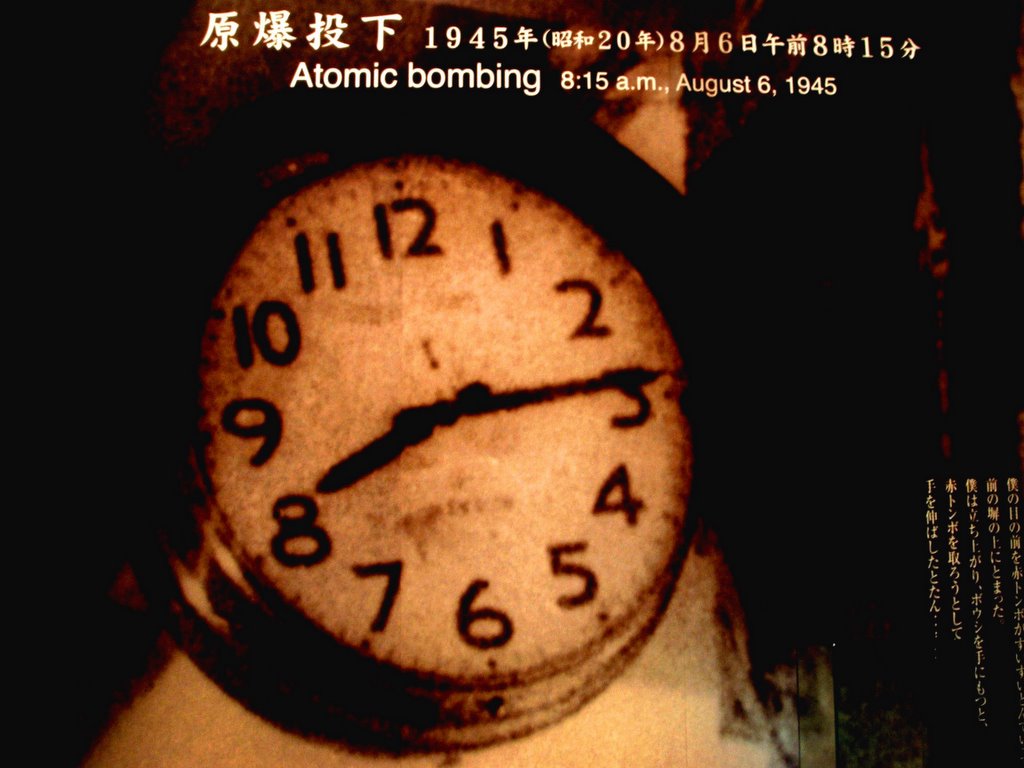
My disposition was a mental one. As I listened to the usual chatter of passers by and watched women walking along slowly as not to outpace their preschool aged children, pushing their younger siblings’ strollers down the walkways, I imagined that on the clear August morning in which the bomb was dropped the scene must have been much the same. The skies were clear blue, the sun shining down, promising a beautiful day ahead; in a matter of moments, everything was suddenly engulfed in the fire of Hell. Near the epicenter, where we were now moseying, little had remained. Buildings, and their occupants, were crushed; trees resembled shooting flames as if burning Iraqi oil wells, while debris hammered everything in sight. People, just like us, walking down the street, were suddenly vaporized.

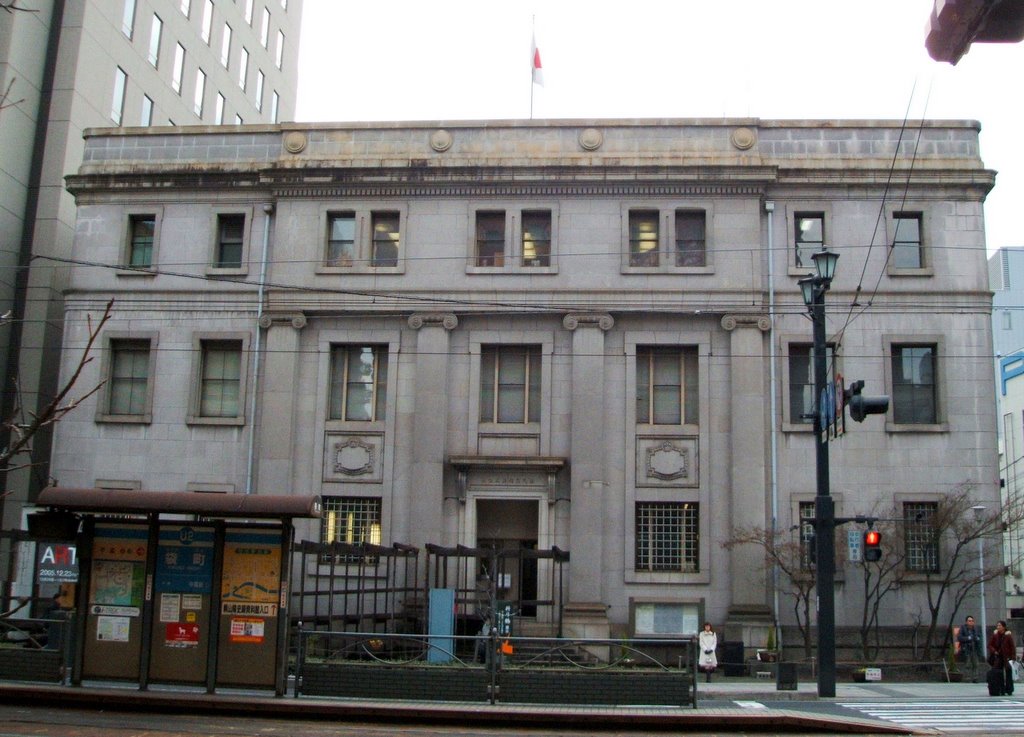
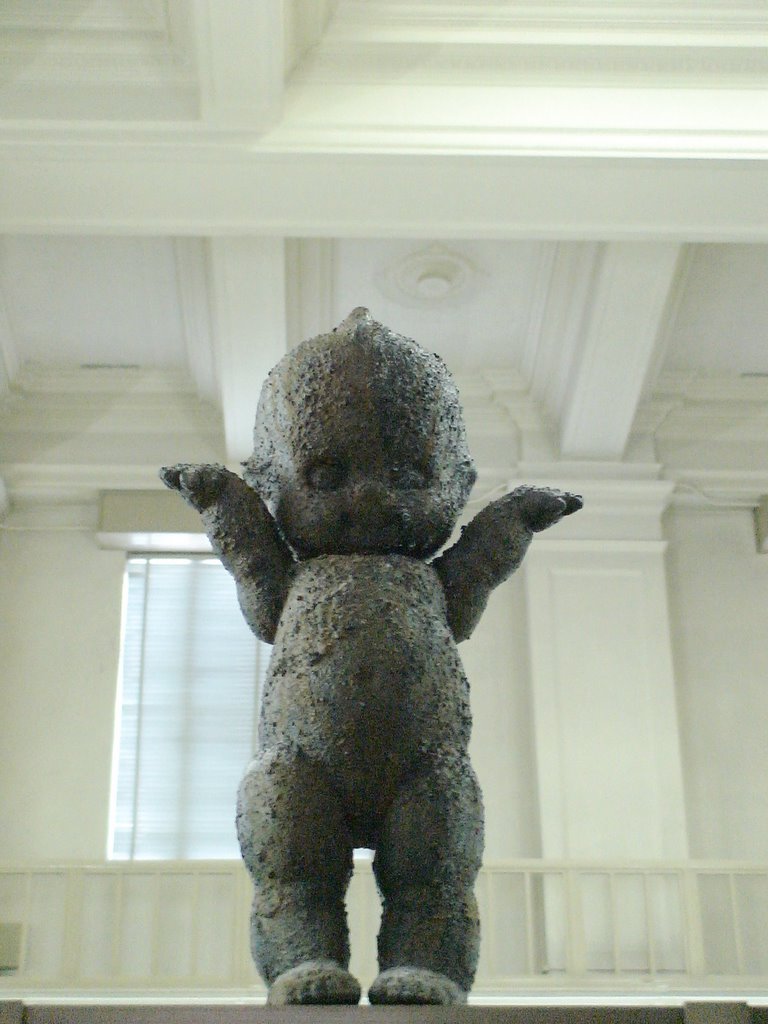
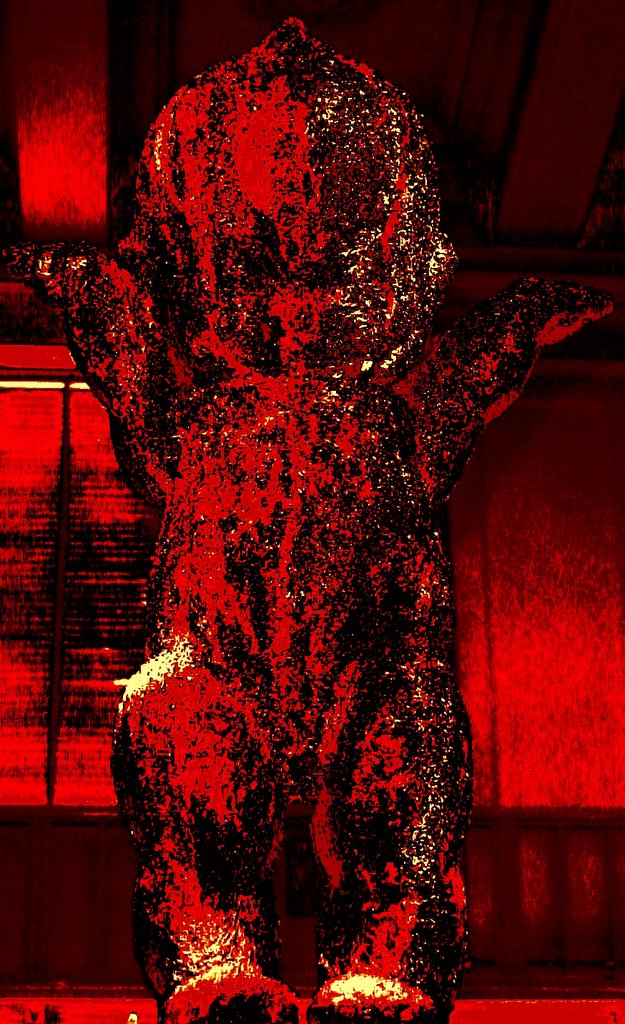
Our first stop, not far from our hotel, was the old Bank of Japan building, one of the few structures that survived the blast, though not so did its 42 occupants, preparing for the day ahead. Having since closed and been donated to the city in 1992, it now is used to host art exhibits. Some its rooms remain as they did prior to the bomb, though most of it has long since been renovated for normal business operation. Stepping into the granite floored lobby, the clicks of our heels eerily echoed off the cold cement walls. Atop of the rail, built to separate the tellers from the clientele, stood an angelic, yet morbid cement cast of an infant child, its skin blackened and sizzled- not unlike the roof tiles that were exposed to the extreme nuclear heat. There were numerous other articles on display that had been present inside on that fateful day of August the 6th, 1945 whose surface bore the same scars, though none sent chills through my body like the effigy of the smiling, blistered infant.

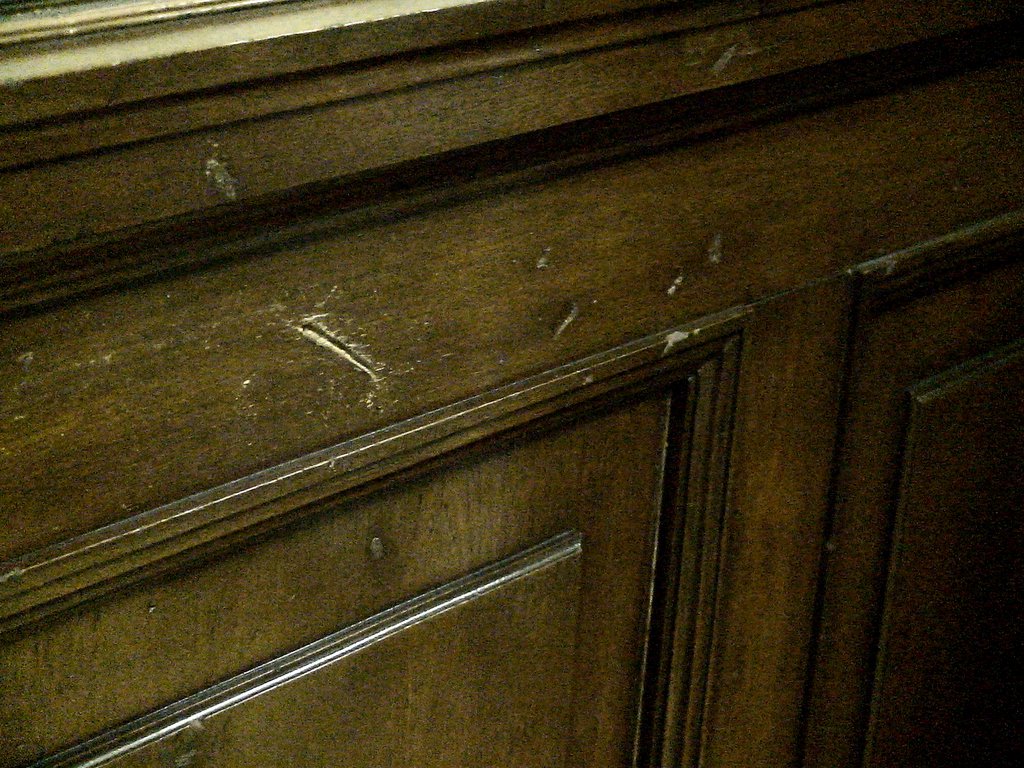
At the time of the detonation, the bank’s iron shutters were closed, protecting the second floor presidential quarters from bursting into flames. The power of the blast, however, shattered the glass panes within them, firing shards in every direction, leaving several gashes in the wooden panels across the room.

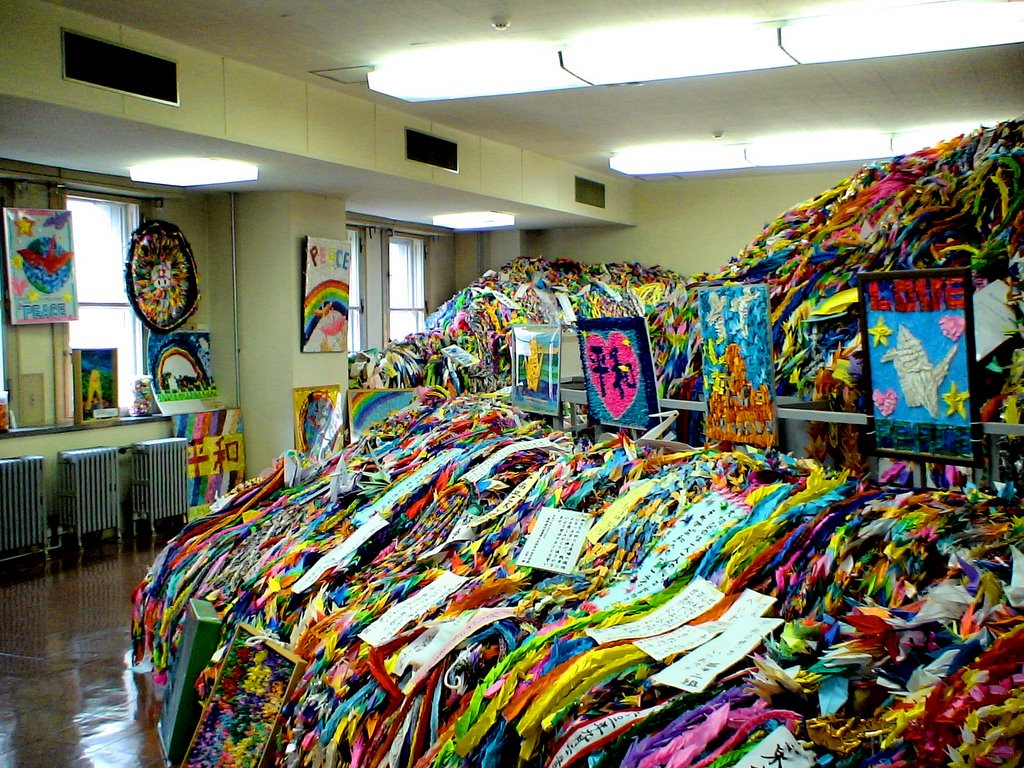
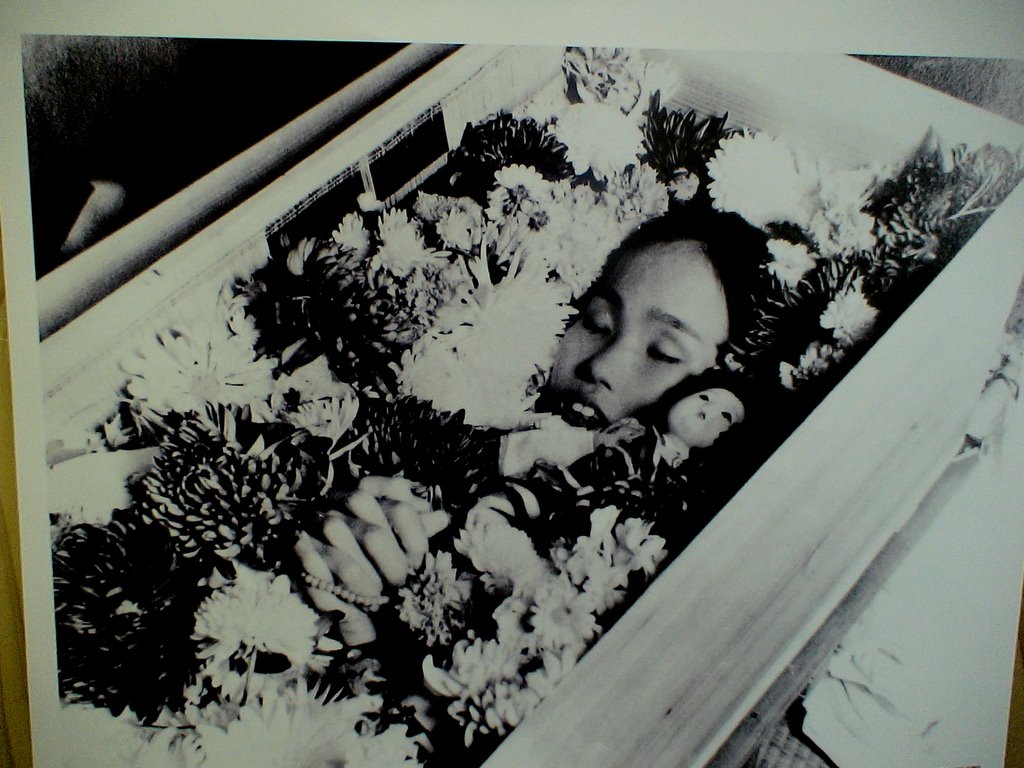
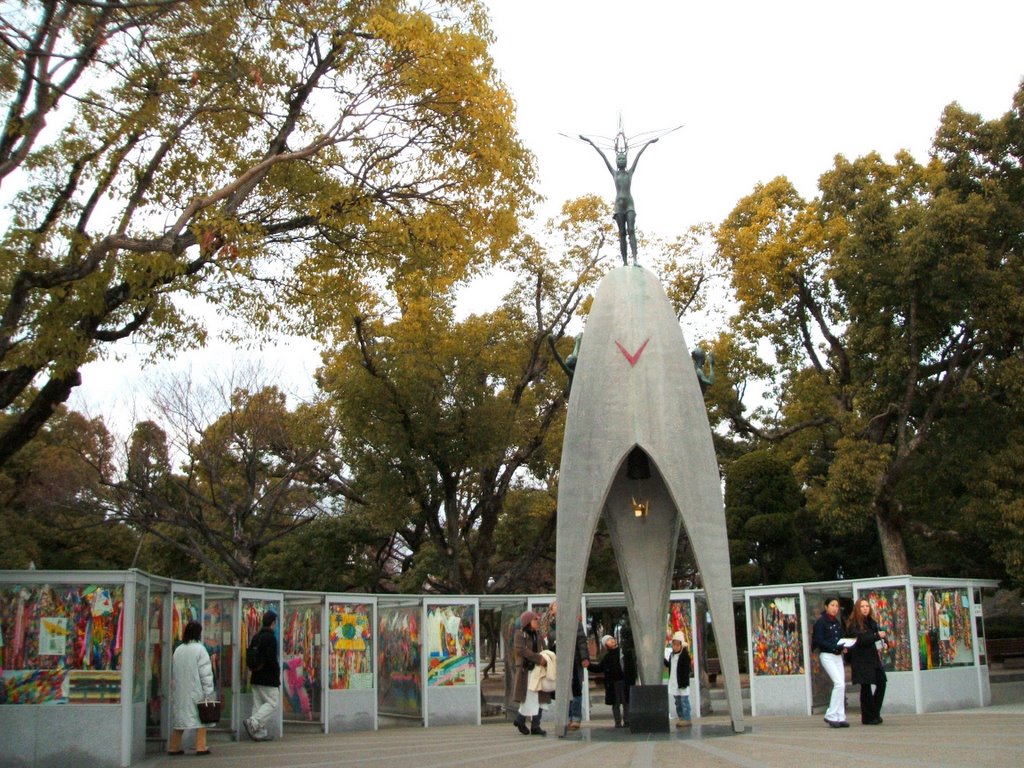
On third floor, which had to be gutted, as did the lobby, were tens of thousands of origami paper cranes, donated to the city, mostly by visiting students, others from abroad, representing in memorial the story of Sadako Sasaki, an eleven year old girl who contracted leukemia from exposure to radiation nine years earlier. Hoping she would recover if able to fold 1000 cranes (after a Japanese legend stating anyone who accom- plished the task would be granted one wish), she passed away the follow- ing year. By some accounts, she died completing only 644, her classmates having folded the remainder, placed them all in her casket. In any event, she died, innocent of any crime, though condemned just the same. Her schoolmates collected donations and succeeded in having a memorial built in her honor paying tribute to the children killed by the bomb.

As we made our way downstairs, into the basement, similar flashbacks, to a time before I was born, continued reeling away in my head. The air was cold but the space well lit. There, in several rooms, were the main exhibits, not at all as intense as the, gaze of the burnt angel forever etched in my memory. One display, a film, depicting the destruction of the current city, as if by a blast, using edited images, spliced together, seemed all too familiar. It was reminiscent of the thoughts that hovered in my brain before and since the visit. One minute, people were shopping at the market, getting on the bus, eating breakfast with their families; the next, they, along with everything around them, lay in ruin.

Not long after leaving the bank building, we crossed a bridge, leading to the Peace Memorial Museum. As with the rest of the city, there were monuments scattered about, reminding us each in their own special way “never to forget.” The first one we stopped to read about was dedicated to Dr. Marcel Junod, a Swiss doctor who headed the International Red Cross of Japan, remembered for his efforts in securing the delivery of 15 tons of medical supplies to the hospitals of the region and for treating bomb survivors within eight days of having been shown photos of the carnage. Prior to WWII, he had been assigned to Ethiopia, following the invasion by Italy, and later to Spain on the outbreak of the Spanish Civil War- a conflict George Orwell joined and wrote about in Homage to Catalonia. Dr. Junod returned to Switzerland in 1946 to write Warrior Without Weapons, documenting his personal experiences as a field delegate for the International Committee of the Red Cross. Later, he became actively involved with the United Nation’s Children’s Fund in China.

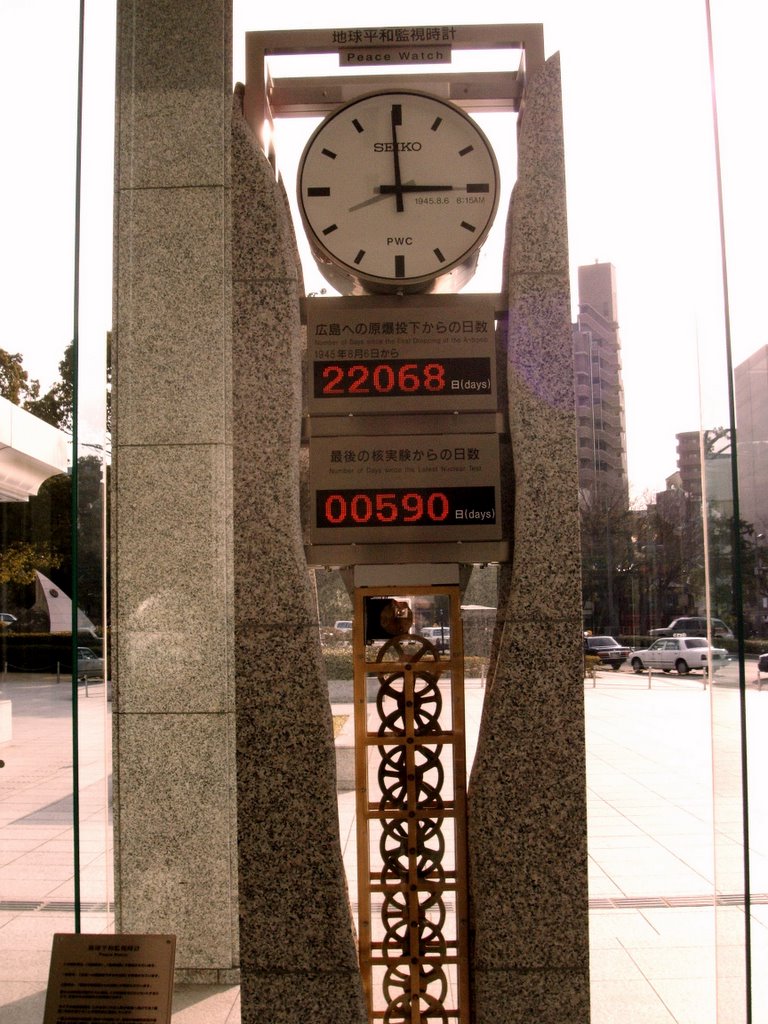
Reaching the entrance of the Museum is a clock showing the current time adjacent to two additional displays: one counting the days since the dropping of the bomb and the other counting down the days since the most recent nuclear weapons test. Entering the dimly lit space was akin to the feeling one experiences when someone boxes their ears- an unseemly pressure builds inside the walls of the skull, hearing becomes as if muffled and a subtle ring begins to sound. At the beginning of the exhibit is a 3 minute film highlighting the tour, which begins with images of the city before the bomb and then eases the viewer into the fury that was unleashed by it. One of the more desperate displays is a series of letters sent to heads of state condemning nuclear weapons testing and pleading for their abolition after the conducting of such tests. Also on display are copies of official, correspondences declassified government and newspaper clippings documenting the lead up to the decision to drop the bomb.

Although President Roosevelt had indeed, eight months before his death, suggested that the atomic bomb “might perhaps, after mature consideration, be used against the Japanese”, Vice President Truman was kept in the dark about the Manhattan Project until after FDR’s passing, April 12th, 1945, three months prior to the first successful detonation test. Once Truman was informed, he became wild with anticipation. Just days before the Soviets, who he greatly despised, were to invade Japan, he signed the order to drop the bomb. His choice in doing so was threefold. He actually went as far as to vaguely and nonchalantly disclose to Stalin that he had in his hands a “weapon of unusual destructive force”, no doubt his way of saying, “I’ve now go the upper hand over you.” At the same time, the Japanese were making arrangements to surrender, though their efforts were hampered due to the emperor’s refusal to denounce his divinity; though absurd as it was, demanding a nation to renounce its god is unthinkable. Knowing this to be the case, the US refused to negotiate. Had we done so, Truman would not have been able to demonstrate our military supremacy to the world, or to Stalin in particular, not to mention having otherwise little to show for the 2 billion tax dollars spent on development. Truman was in such a rush to show off his new toys that his scientists were unsure as to whether or not they would actually detonate (recall, there were only two in existence up that point); unfortunately, they did. Some of these statements were included in the exhibit, others I had prior knowledge of.

As we made our way upstairs, we looked at the path of rebuilding, of hope. There were rescue accounts and struggles of surviving a nuclear attack. I imagined all the people who came to attempt to ease the victims’ suffering out of great personal risk. Hospitals were largely in ruins, though the Red Cross building managed to maintain some of its facilities; supplies were obviously in short quantity as was medical staff, having also been counted among the dead. Whenever I saw an elderly person, I silently wondered if they were among the survivors. Dr. Junod, and others like him, tried desperately to do whatever they could in the service of the dying; true heroes, all of them.

The third floor of the east wing was largely about the nuclear age as it relates to science. There were demos about the number of nuclear armed countries and maps indicating where nuclear testing had been conducted. Of note was a section illustrating the arms race, which began with the Truman Doctrine, and the continuing legacy that haunts the world still. Around the corner was a display of testimonials from world leaders and religious figures, including Pope John Paul II, Mother Theresa, and the Dalai Lama, calling for world peace and solidarity. By this time, however, the closing announcement was aired over the PA system. After about three hours of taking in one of the history’s most tragic events, we decided to call it an afternoon and to return Sunday to continue our tour across to the west wing.

As we exited the building, there I was again, visited by unsettling thoughts, a natural reaction to attending such an exhibit. I made Asr shortly before sunset, saying a prayer for the victims and for an end to the many wars afflicting the world’s people. Afterwards, we went to the library on the first floor of the west wing, separated from the rest of the exhibit. It offered some well written books, critical of both sides of the war, some of which were composed strictly of primary sources. Having taken in our fare share, we left without reading much. I prayed Maghrib and then we set out on an evening walk.

Friday, January 20, 2006

Homage to Hiroshima: Day Three

Out of the interest of time, we spent the second day of our trip in Miyajima, an hour train ride outside the city (a separate entry that will appear shortly). Upon our return to the museum to visit the west wing and the rest of Peace Memorial Park, I was anticipating another emotional rollercoaster. Knowing how quickly the time passed during our initial visit, we quickly passed by that which we had already viewed. We did, however, want to make a stop at the bookstand. Available were an abundance of books for both children and adults on a variety of topics relating to the nuclear issue and WWII. I left with three titles; two on Hiroshima: The Spirit of Hiroshima, published by the museum, and a children’s book, The Story of Barefoot Gen, about a Japanese family who opposed the war and were ostracized as a result but nonetheless held firmly to their believes despite outside threats. The third title: A Different Kind of Nuclear War: Children of the Gulf War, highlighting the cancerous effects of depleted uranium, used by the US armed forces to strengthen the piercing power of conventional ammunition. Although prohibited by international law as of 1998, having been classified as a weapon of mass destruction in 1996 for its devastating effects on populations living in the areas where it was used years after the fact, it continues to be used on the battlefields of Iraq. After purchasing too few books we made our way to the next exhibit.

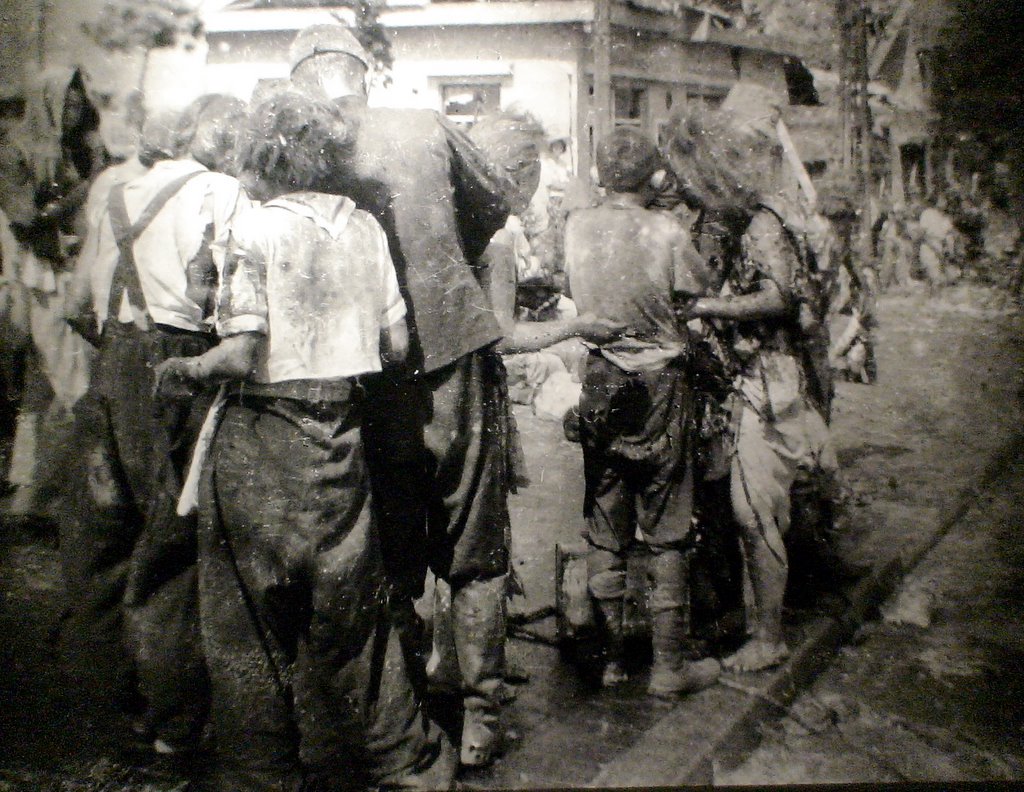
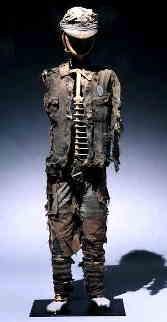
The west wing is accessible via a long, somewhat claustrophobic sky bridge, with small square windows placed just below eye level, so that one had to crouch down slightly to look out, and walking on what sounded like a hollow floor we approached the other side. As we walked around the dark corner of the corridor we entered what resembled a nuclear war zone; crumbling brick walls, shattered glass and human replicas emerging from the fiery wreckage, their skin dripping from their bones like wax melting down a candlestick, the result of the intense heat of the nuclear reaction. This re-enactment, as it were, demonstrated the immediate experience of the blast- these victims, of course, were beyond hope for survival. In this area were also clothes worn by school children that dreadful day, burned and tattered. Most of them died a slow, painful death. Also on hand were articles that they had in hand on their way to school that morning. One that sticks out in my mind was a lunchbox that looked as though it had been excavated from a few feet of earth. The outside was clean but the inside revealed what appeared to be a dirty, rust covered clump of dirt; actually it was a child’s lunch that his mother had prepared, having been burnt to a crisp by the same heat that charred his skin.

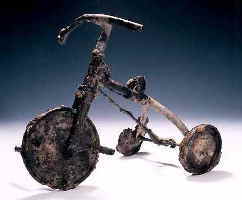
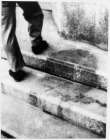
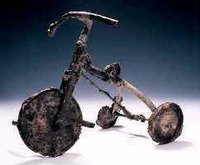
There were artifacts of all sorts to be viewed. Many were ordinary items, including roof tiles and cement Buddhist statues resembling the infant figure displayed at the bank, their surfaces blistered. There were warped bottles and ceramic tea cups that had been bound together by intense heat. Accompanied by a rusted out tricycle, caked with soil, was one families story of Shin, their three year old child who fell victim to the bomb. Having been unable to save Shin’s sisters, his parents managed to pull him out from under the beams that had collapsed over him as he rode his tricycle in circles in the back yard. They rushed him to the river to try to quell his burns but without success; he died during the night. With no decent means for proper burial, his father dug a hole in the backyard where the child used to enjoy riding, and buried Shin along with the trike he so cherished. Forty years later, his mother convinced the father to raise their children’s bodies and place them in a more appropriate grave. As they were uncovering Shin’s “little bones”, they found his tricycle and donated it to the museum. One rather interesting display was a section of a cement wall, punctured by quarter sized piece of shattered glass, demonstrating the immense power released from the blast. Another large display, featuring of section the step, taken from the front of the bank, was inked with the shadow of a man who sat outside, waiting for the doors to open, unaware of what was about to occur in a few moments. The gamma rays from the bomb were so powerful that the flash produced a camera- like effect, casting permanent shadows on the ground. Considering all 42 employees were killed instantly within the thick concrete walls of the building, the customer waiting outside evaporated on impact.
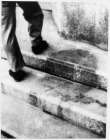
Aside from remnants left in the wake of the atomic bomb were also aftershocks that continue to reverberate through Hiroshima. On display were photos of burn victims, their skin scorched and raw, bandaged in puss drenched rags, in addition to removable tissues such as hair and disfigured fingernails. Preserved by taxidermy was a malignant tongue, twisted and abscessed, from a soldier who contracted cancer after radiation exposure. Other infected body parts were preserved in formaldehyde in a tasteful but disturbing manner.

Among the final exhibits were further scientific explanations of radiation’s harmful effects. Some people ask how it that Hiroshima is not still saturated with it. Apparently the residual radiation dissipated quickly, leaving only 20% by the next afternoon. Nowadays Hiroshima’s levels of radiation are no greater than a city that hasn’t had a nuclear accident. In other words, it’s not a Hanford or Chernobyl, despite being exposed to an actual atomic explosion. The last stretch featured testimonials and drawings from the survivors. After reading them, we made our way through the park.

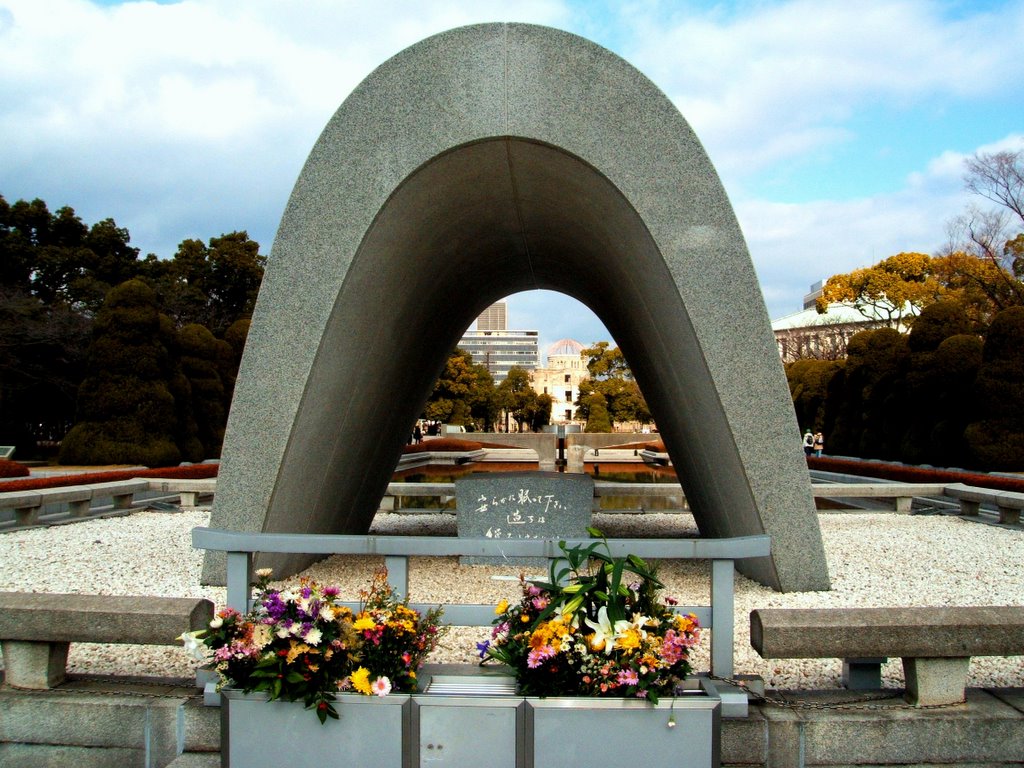
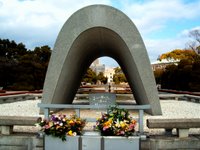
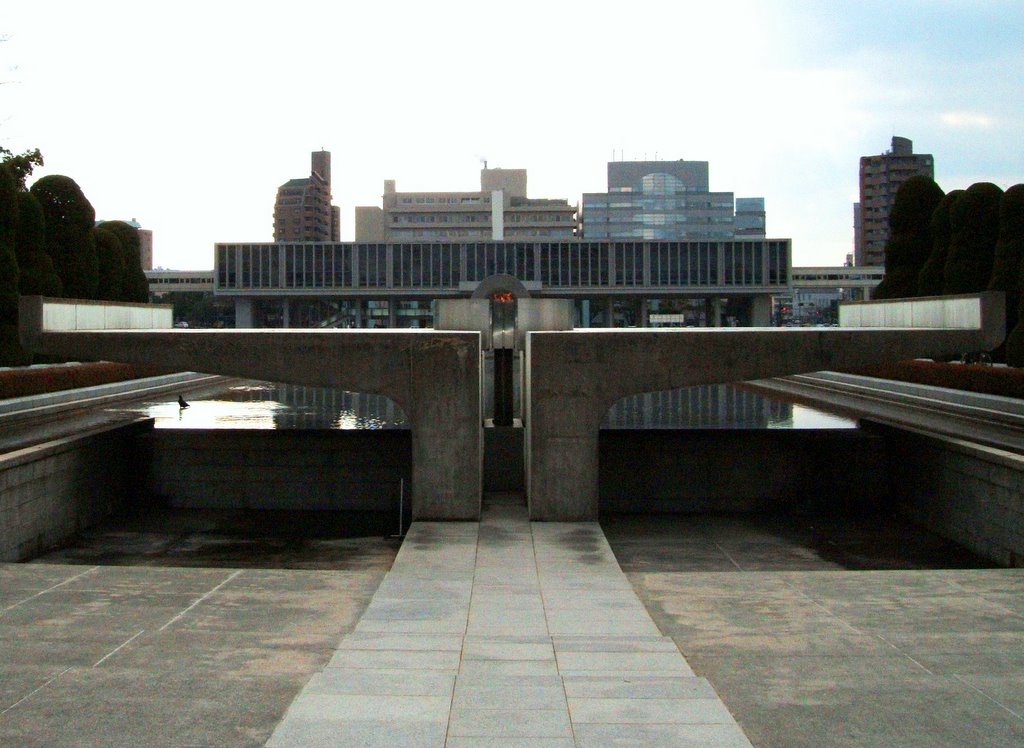
The park’s center feature is the Peace Arch, dedicated to honoring the souls lost to the bomb. Beneath the austere structure is a vault containing names of more than 226,870 bomb related deaths, 79 volumes deep- many having perished decades after the attack; included are Chinese and Koreans who were enslaved by the army as well as the American prisoners of war also among the dead. We offered our prayers of mercy for the fallen. Beyond the arch burns the Flame of Peace in remembrance of those whose thirsts could not be quenched while also serving as a sign of solidarity against nuclear weapons, aflame “until the day when all such weapons shall have disappeared from the earth."
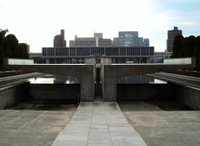
A recent addition to the park is the Hiroshima National Peace Memorial Hall for the Atomic Bomb Victims, dedicated as both a memorial and educational and research center. Walking down into its modest spiraling pathway each step could be heard as if we were inside an empty tomb. The info guides provided, written in several languages, allowed us to access the personal memoirs of the victims, most containing an image as well, are an indispensable primary resource. Included is a library, featuring documentation and videos, related to the victims and their city. It’s shameful that the United States doesn’t have it’s own such research center but would rather keep it’s citizens in the dark, redirecting the funds toward promoting military recruitment in high schools and maintaining an aggressive, pre-emptive foreign policy.

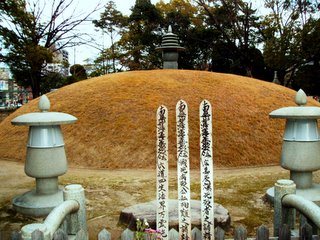
Yet another sullen testament to the dead is the Memorial Mound, housing the ashes of more than 70,000 people. In a rush to rid the city of decomposing corpses, bodies were dragged from the streets and rivers to an area in the northern area of the park and cremated. Many of the ashes have been reclaimed over the years and given an individual burial but since many of the victims consisted of entire families, some were simply impossible to identify under the conditions at the time. Upon the mental images of piled bodies and the smell of burning flesh that must have enveloped the area, seeing the mound was enough to make the most callous of generals weep. Again, we offered our solemn prayers of mercy to those whose ashes were buried underneath the mound of earth that rose before us.
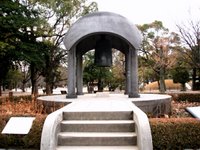
As if to release our sorrow, we approached the steps leading to the Peace Bell, housed under steep domed rooftop supported by four cylinder columns, modestly constructed. Carved into the surface of the bell is a map without artificial boarders, meant to symbolize “one world” reminding me of the words of John Lennon, “imagine there’s no countries.” We each took a turn at pulling back on the wooden plank, letting go and striking the bell. With each pound, a soft echo rang throughout the park; a soothing, comforting sound. Each August, on the anniversary of the bomb, several bells are rung to commemorate the “One Hundred Sounds the Japanese People Wish to Preserve.”
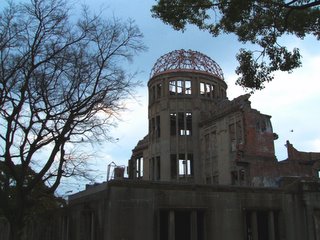
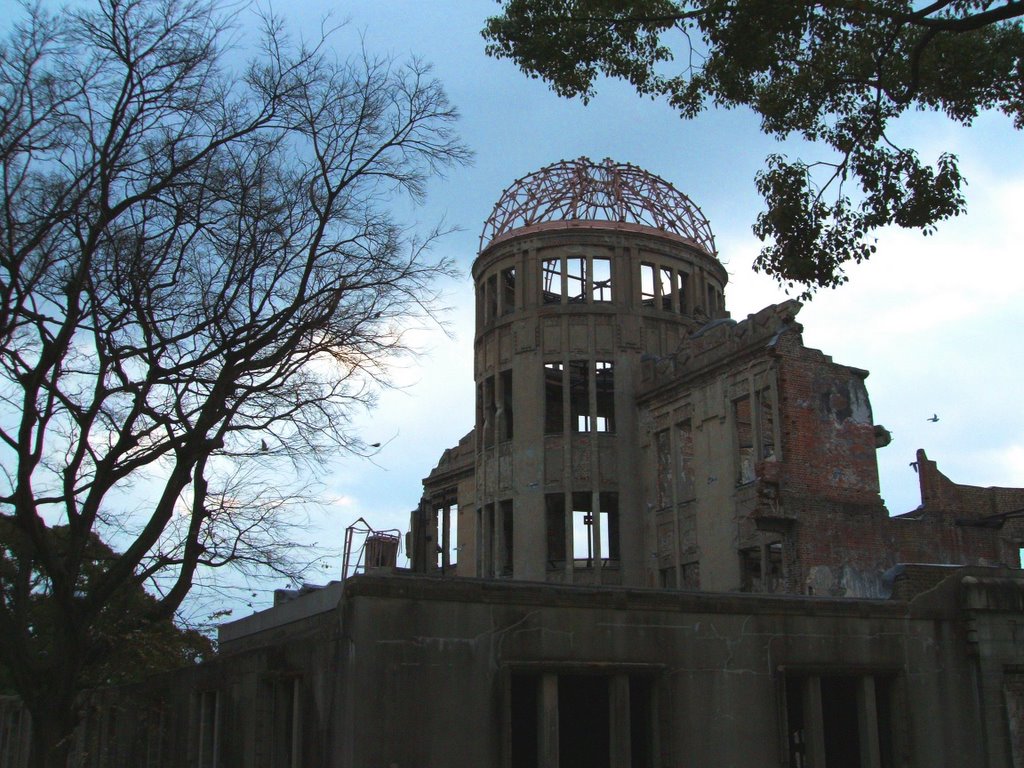
Across the river stands the infamous Atomic Bomb Dome, twisted in ruin, appearing as if since untouched at first glance. Over the years reinforcement beams have been added to prevent its collapse. As with the Bank of Japan building, upon detonation everyone inside was killed instantly. It was there, just 600 meters above, that the bomb was deton- ated. It looked as though the hammer of Satan had pounded the surrounding grounds, causing the earth to tremble and the bricks to fall, as if they’d never been cemented together. One of the few remaining buildings, once among the city’s most adored, initially named the Hiroshima Prefectural Commercial Exhibition Hall, its presence stirred up many painful memories among those who had survived. For twenty years, it merely remained as a condemned eyesore that many wanted dismantled. A city council vote upheld the decision to maintain the structure as a living example of the threat posed by nuclear weapons. In 1996, it was registered as a World Heritage Site, a controversial move that will surely continue to leave an imprint on the memories of all who travel there to see it.
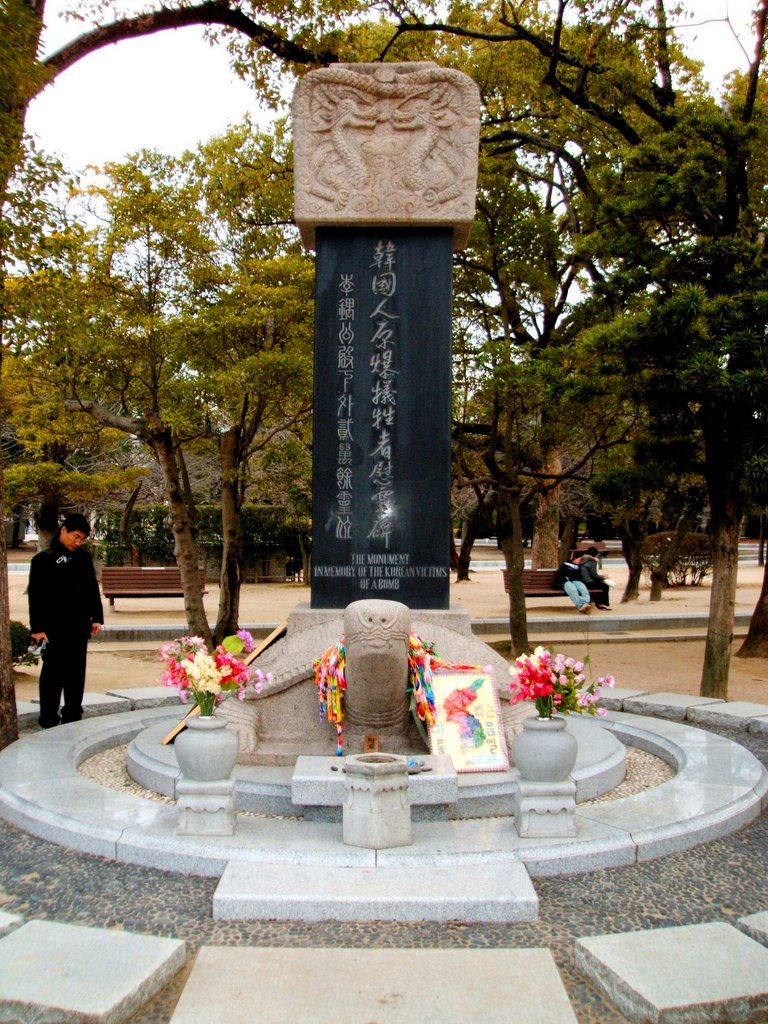
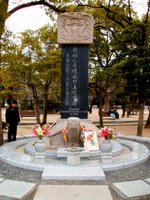
Having made my afternoon prayers nearby, we ended our tour of Memorial Peace Park. Though my account may seem like a grim one, I encourage everyone to who travels to Japan to make this important stop. The exhibits are tastefully and objectively displayed. In fact, I was surprised to see that the strict militarism of the Japanese was held also held accountable for what happened. They were, after all, seeking to dominate the South Pacific and large portions of the Asian continent, something western imperial powers were not willing to allow. The Japanese Army was no doubt a vicious occupier of Taiwan, Korea, the Philippines, Indonesia, Singapore, and other areas, to be sure. Koreans were enslaved by the army and forced to endure rape and hard labor while looking down the barrel of a gun. In their own country, they were forbidden to use their native language, something that the current government in Tokyo is now writing out of the textbooks, along with the rape of Nanking, China, as if it never happened, furthering mutual resentment. The Korean victims of the atomic bomb were also denied reparations received by Japan from the United States- the memorial pictured didn't even become part of the park's landscape until 1999, despite the 50,000 who were killed.
Reconstructing a laundry list of war crimes committed by Japan would be an easy task. In so doing, however, one should take into consideration the fact that had Japan, or Germany, for that matter, dropped the bomb, the act would have indeed been considered a war crime, as Leo Szilard, one of the leading scientists who helped to develop the atomic bomb later noted. Those whose heads were hung at the close of the Nuremburg Trials, largely were condemned for acts of aggression, something every single US Head of State has been guilty of, including George W. Bush. As long as we’re the victors over our enemies, we’ll never be held to account, just as the Allied Powers of WWII were exempt from the trials at Nuremburg, though obvious atrocities were committed.

As we returned to our hotel in preparation to board the train back home, I paid my final respects to a city that I will always consider to be the most important of all I have visited in Japan, I hope to someday return with my children, insha’Allah. As long as this entry wound up being, it is far from completion. To give an adequate account would mean writing a book. There were many sites that I overlooked or didn’t have the time to visit. It’s those reasons that bring us back years later. Such visual reminders help us to maintain or open our eyes to the sick reality of modern warfare, which would have been condemned by any prophet of God. Seeing that Muhammad, peace be upon him, was the last in the prophetic succession, it should be recognized that he forbade the killing of civilians, now dubbed “collateral damage.” Also prohibited was the use of fire, the poisoning of crops and animals- though admittedly one wouldn’t know it by those carrying out such attacks in the name of Islam, but neither would Christ, peace be upon him, have blessed the slaughter committed by the crusaders or the war currently raging in Iraq, killing thousands.

Obviously I’ve made my position clear in regards to whether or not the use of the bomb was justified. I’ve listened to the argument that “the Japanese were ready to fight to the death,” and so it had to be done to save lives. Of course they were ready to fight to the death; that’s the essence of war. That aside, General Douglas Macarthur said a military justification to the use of the atom bomb didn’t exist. General Dwight D. Eisenhower likewise stipulated that the Japanese had already been virtually defeated, making the bomb absolutely unnecessary. As a teacher of history, I’ve yet to see these testimonials printed in any state issued high school textbook, again demonstrating the arrogance of the victors. It’s much easier to erect a Holocaust Museum to honor the victims of the Nazis than it is to recognize one’s own crimes against humanity. The fact that there exists no such grand memorial to pay tribute to the tribes who were exterminated to make way for the settlement of the western frontier nor one to recognize the tens of millions who were forced into the bowels of slave ships and worked to death building the mighty American Empire, testifies to the hypocrisy of nations. Until the perpetrators of crimes against humanity can admit their own guilt, much like the Germans were forced to do after WWII, as did later the South Africans during the Truth and Reconciliation Commission, at the close of Apartheid, the embers of resentment will continue to smolder, rendering any real attempt towards peace impossible.
Tuesday, January 10, 2006

As-salaam Alaikum & Eid Mubarak!


May Allah Bless you, your actions be well intentioned and rewarded. Blessed are those who strive to please thier Creator and Sustainer, insha'Allah, God willing; may we all be included in the company of the upright. May all oppressed people everywhere hold steadfast to faith and be given justice in this life and the next, insha'Allah. And may Allah Bless us all with lasting Peace. I wish you all the best in the year to come.


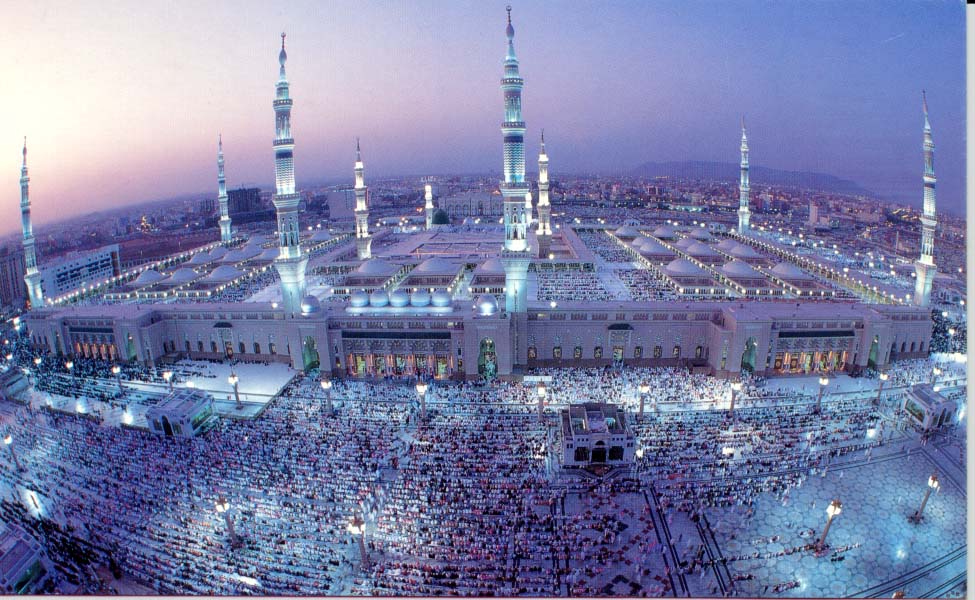
To my non-Muslim brethren, Eid al-Adha is one of only two universally celebrated events in Islam, the other, Eid al-Fitr, concludes the Holy month of Ramadan. Translated as “the Festival of Sacrifice”, Eid al-Adha commemorates Prophet Ibrahim’s (or Abraham's), complete submission to what he believed was Allah’s command to sacrifice Ishmael, his first born son, may peace be upon them. Having demonstrated his willingness to make the ultimate sacrifice, Ibrahim was stopped at the last moment from carrying out the slaughter, thereby proving to himself the strength of his faith. In addition, Eid al-Adha brings to a close the Hajj, the annual pilgrimage to Mecca and Medina, the largest of its kind, comprising of more than three million worshippers.

Masalaama, Peace be with You

Monday, January 09, 2006

Happy New Year from Japan!


Last year, I traveled to so-called “sunny California” to celebrate the holidays with my family. The weather was perfect: blue skies, warm cozy temperatures, and cool breezes… the week before I arrived, that is. During my two week vacation (my first in California), the sun only emerged from the damp and dreariness a handful of instances. Family time was great but the weather hindered our options. It was also during this trip that I announced my intensions to marry, something I wanted to do personally.

This year, I planned to remain in Japan to celebrate the dawning of the new year. Unlike the in the States, the focal point of celebrating New Years is not on its eve. The celebration is recognized over the first three days of January, although the equivalent to “spring cleaning” is done to freshen up for the new year, followed by eating “long life noodles” on December 31st (oddly enough, also an Italian tradition- just a guess, but perhaps it began with the Chinese, who concocted the noodle). The following days are typically time spent with family, especially grandparents, not unlike Christmas in the west; stores are closed and streets are empty- on day one at least.

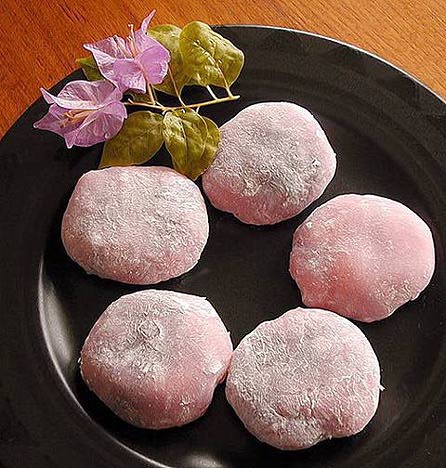
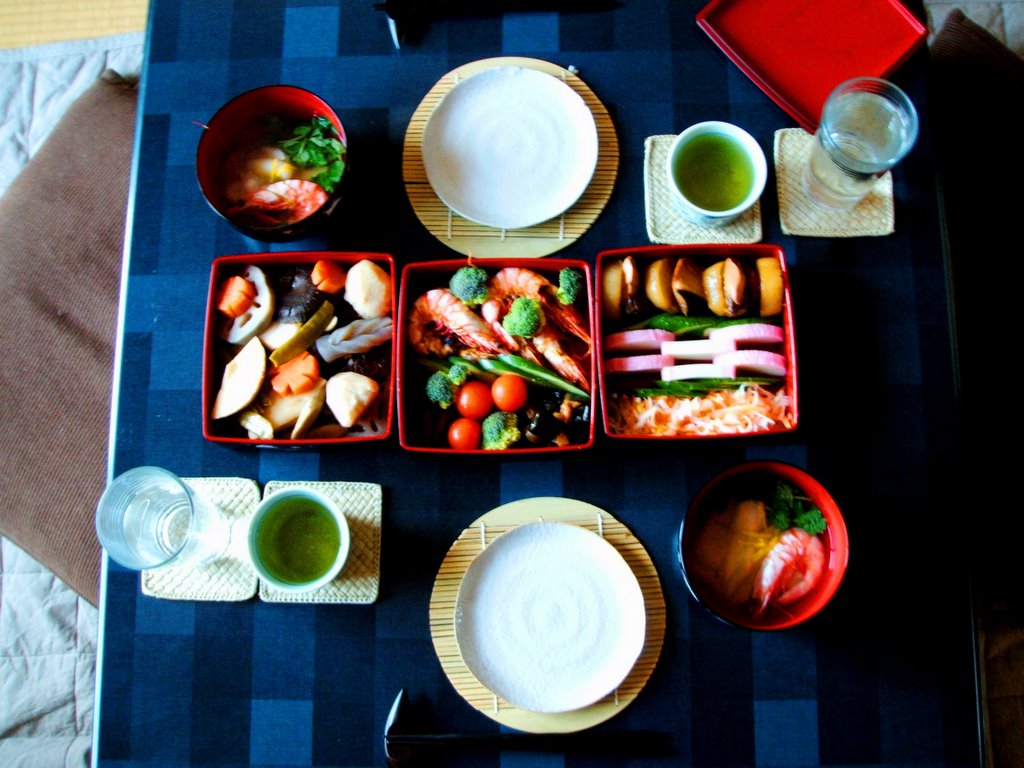
January 1st is marked with a special meal, osechi, consisting of a variety of vegetables, rice, and fish, along with miso soup followed up by macha (green tea), and mochi (soft rice cake). Traditionally, mochi was made by husbands and wives who, after steaming large quantities of sweet rice, placed it into a huge granite bowl, resembling a large herb mortar, while her partner whacked it with a sledge hammer-sized, wooden mallet, producing a soft, doughy mass. Still a popular activity on the countryside, most suburbanites today lack the space for conducting such an endeavor, settling for a store bought version. In either case, it’s quite delicious. Most families, secular and religious, traditionally visit a shrine as well- the one place where large pockets of people can be found.

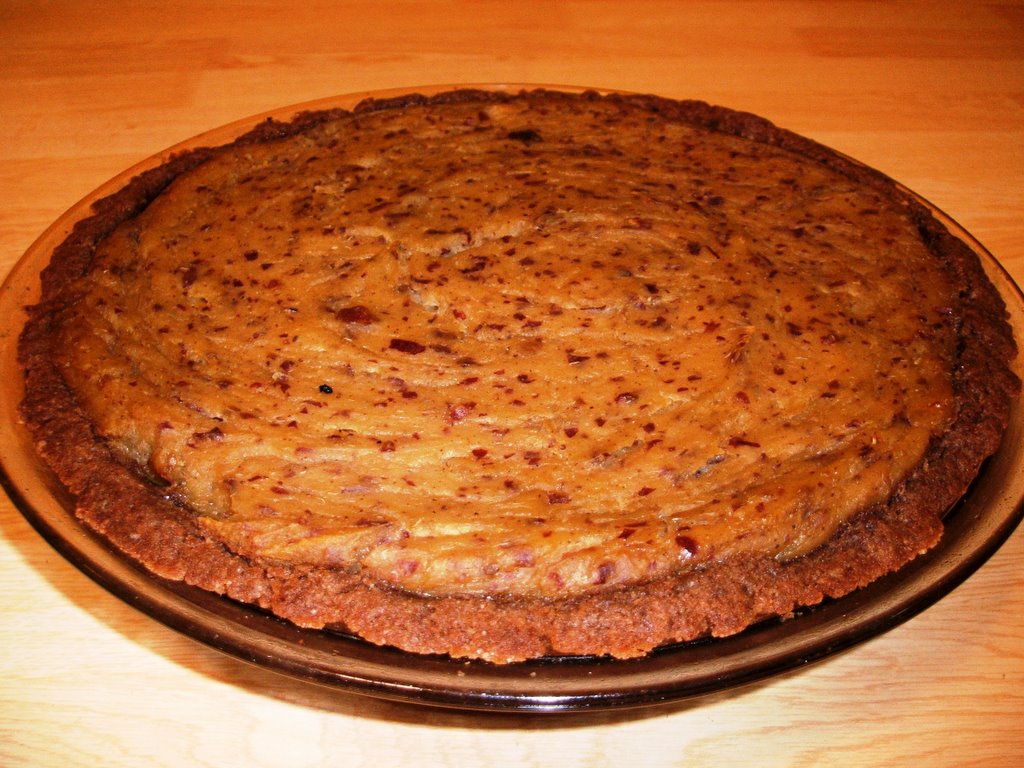
The remaining days are spent mainly in hiatus or going out with family and friends to karaoke, bowling, and the like. Unfortunately, for me, I was still battling the flu, that by this time had attacked my lower back, leaving me restricted primarily to my bed- I didn’t leave home for a week! I did manage to stand up long enough to throw together a sweet potato pie, but it wasn’t easy and I paid dearly for it the next day. One tip I discovered to greatly enhance the flavor of baked sweet potatoes (although fine by themselves also): break off some cinnamon stick and toss it into a covered baking dish, along with an inch of water, and bake for about an hour- amazing. As I wasn’t good for much more, Tsugumi made her debut osechi- I couldn’t imagine anything better!

After dinner, I made my way back into bed, where I laid for the next two days, reading Dostoevsky’s The Idiot, slowly recovering from the last waning remnants of the flu. My biggest regret, of course, was not being able to spend the time with the extended family, which Tsugumi largely made up for, al-humdulilah.

FAQ: How is that the Japanese New Year is on January 1st if it’s based on the Chinese calendar? Answer:
Along with many aspects of Japanese culture, traditionally, the calendar is based on the Chinese version, which identifies New Year’s Day as the "Spring Festival", beginning after the second new moon, following the winter solstice, hence, is also lunar based. After the Chinese were toppled by the British opium cartels and during the time in which the Age of European Imperialism was ravaging the world, the Japanese turned from China to Europe for inspiration (ironically, later returning Manchuria to colonize it themselves). To make a long story short and keeping to the subject in question, the Japanese kept the Chinese Zodiac but adopted Gregorian timeline. To further complicate things, however, the numerical calendar year corresponds to the number of years the current emperor has reigned. So, while, according to the Christian calendar, 2006 officially began on January 1st, year 18, specifically, Heisei 18, of the emperor’s reign also began.

Tuesday, December 27, 2005

Winter Time Flu Season

Okay, so most of you are probably wondering, “where’s my New Years card from Zain? What, he doesn’t celebrate that anymore either?Wrong. See, every year, I type a bunch of letters out and send them to people around the planet. In Japan, it’s a little tricky. One: stamps are $1.10 each; two: I don’t have a printer so I have take care of that at the office. To top it all off, as of this week, I’ve come down with the flu- doc said ‘type A’ so I guess that’s a doosey. I’ve had to put my Hiroshima plans off a week and haven’t been much use to anybody except the gas and electricity guys, who, because houses are built without insulation here, are making a grip off of me this month. I have to keep the heat on all the time if I plan to stay warm- between fever outbreaks, that is. On a windy day, it’s like sleeping in a barn- the draft literally rattles the doors. My flat is less than ten years old to boot. Anyway, don’t give up on me! I will manage to get them to you! Until then, have a Happy New Year!

Saturday, December 24, 2005

So this is Christmas...

The snow has arrived! I love this time of year. So many childhood memories of snowmen, Christmas decorations, baked goodies, and family time are brought back with the coming of the season. There is no other collective memory that I can recall from my childhood that are more special than these. It was the one time of year when the whole family came together to celebrate, exchange Christmas cheer, and renew our bond.

The scents of the freshly cut evergreens, steaming hot cocoa, and Mom’s homemade fudge, right out of the oven, still permeate my senses so much so that if I closed my eyes and opened them again, I wouldn’t be surprised to awake and find myself there, listening to Grandpa’s stories, and nibbling on sugar cookies and candy canes. To this day, I delight in watching A Charlie Brown Christmas, Fat Albert’s Christmas Special, and Rudolf the Red-Nosed Reindeer.

So, why is it that I no longer celebrate Christmas? With all the joy that it brought, why wouldn’t I wish to continue the tradition with my own family? Principle. It’s not that I regret all those wonderful years of family time intended to honor the birth of Jesus, peace be upon him, (as is often assumed by people who misunderstand my faith). On the contrary, it’s the opposite.

Other than in namesake, Christmas, i.e., Mass of Christ, has nothing whatsoever to do with the teachings of Jesus. I can appreciate those who say “Jesus is the Reason for the Season” and to “keep Christ in Christmas.” Despite their good intentions, however, Christ never was the reason for the season. He didn’t teach us to cut down and decorate trees, eat ham, hang mistletoe, or exchange gifts in honor of his birth. Not unlike those before him, his teachings taught us to submit to the Will of God and to practice all that that encompasses, i.e., charity, honesty, patience, and consistency, to name a few.

In the beginning of my journey in Islam, I celebrated the Virgin Birth and had thought it important to remember the teachings of Jesus on Christmas, in hopes of salvaging some measure of spiritual significance. I had no problem celebrating the birth of a prophet of God, for as Muslims, we celebrate the birth of Muhammad, peace be upon him, every day. The Qur’an teaches us not to place the importance of one prophet over another so there wasn’t any apparent contradiction my actions.

Unfortunately, my upbringing did not prioritize Jesus as the focal point of Christmas, despite being raised in a Christian home. We were not Catholic, so we didn’t attend Midnight Mass. Like most families, we had our Christmas Eve traditions; ours consisted of eating cookies with milk, and opening one gift of choice. The next morning, we would wake up to find the gifts that “Santa” had left us. Mom and Dad would get up, make breakfast, and later we would open the beautifully wrapped gifts that had been gathering under the tree. Except for “knowing” that Jesus was born on Christmas Day, there was no correlation drawn. The Bible wasn’t taken out and read, we didn’t attend a religious service or anything of the sort.

The fact that this was common practice within most families, who celebrated Christmas, concerned me. I imagined a day when people would know nothing of Christ, in whose name they were celebrating. That day is upon us. In Japan, Christmas celebrations are abundant, yet less than one half of one percent of the population is Christian. Similar to Christmas in America, it is simply an excuse to go shopping and indulge in sweets, or worse, it has become a national date night.

Ironically, Christmas has become a day when sincere Christians are trying to keep Christ in the celebration, while most others have forgotten all about the event that supposedly corresponds to his birth and in many cases entirely discount any religious significance to December 25th. As it happens, the latter are closer to the truth than most Christians would care to admit. In fact, a large list of pagan deities were given birthday celebrations on or around this day, including, Mithras, Horus, Dionysus, Hercules, and a host of others.

Scholars have found that the Virgin Birth actually took place in autumn or possibly spring, not the end of December. Historically, sheepherders kept their flocks indoors during the winter months, whereas the New Testament describes Jesus’ birth as having taken place when the flocks were being tended in the fields. Christmas became the day designated to celebrate the Virgin Birth in 350 CE under the leadership of Pope Julius I, an attempt to streamline the Roman public into Christianity. The ancient festival of Saturnalia, commemorating the birth of Saturn, god of the harvest was essentially coopted by the church which gradually replaced the names of pagan practices with holy ones. In practice, however, the celebration changed very little. The excess of feasting, drunkenness and debauchery continued to mark the days of the solstice to the extent that the Puritans actually banned the public celebration for twenty two years; in England, the church fathers instituted a day of fasting.
Like everything else associated with Christmas, December 25th is pagan in origin. Nowhere in the Bible does God tell us to celebrate the birth of Christ on a designated day, nor did the early Christians do any such thing. The day itself relates to the winter solstice and Yuletide celebrations, honoring the Germanic pagan deity Jul, whereby followers hung mistletoe and slaughtered pigs, hence the customary Christmas ham. Odin, another pagan god, was said to the great hunt for the wild boar, became associated with the Christmas character of Santa Clause. He is said to have rode upon an eight-legged horse and would fly down to people’s homes, leaving gifts inside the boots of children who would leave carrots and straw for his flying horse. The myth of Odin merged with St. Nicholas, and boots became stockings, yet the traditions remain (although children in various countries continue to put their shoes out for Santa on Christmas Eve).

Today, the gifts are usually set beneath a Christmas tree. Ironically, the concept of cutting down trees and decorating them is explicitly condemned in the book of Jeremiah 10:1-4: "For the customs of the peoples are worthless; they cut a tree out of the forest, and a craftsman shapes it with his chisel. They adorn it with silver and gold; they fasten it with a hammer and nails so it will not totter. Like a scarecrow in a melon patch, their idols cannot speak; they must be carried because they cannot walk." Historically, there are various European traditions, influenced by the Romans who were themselves inspired by the Babylonian, which included the use of evergreens and fir trees to mark everything from fertility to birth stories of ancient gods.

Most blasphemous, perhaps, is the “Nativity of the Son,” son, referring the “son of God”−a concept that Muslims and Jews object. The Virgin Birth, as depicted in the nativity scenes displayed at Christmas time to honor Jesus, has been intertwined with the births of the sun gods of the Roman Empire and the Greek Empire before it. As the shortest day of the year had come to pass, the sun was believed to have been reborn. In actuality, “son” and sun have become one and the same. The choice to observe December 25th had more to do with an attempt by the church fathers to coopt a pagan festival than establish a new morality; a decision that would prove difficult for the church authorities in their hope to curb pagan practices.

Of course today, people, especially Christians, are not cutting down trees to worship them. It is simply a cultural tradition, just as is gift exchanging and the other activities associated with Christmas. These traditions, however, are still of pagan origin. All three of the Abrahamic faiths, Judaism, Christianity, and Islam, are instructed not to do as the pagans do and to worship God alone. There is no compromising this commandment. Nor did Jesus teach his followers to engage in mass consumption in his name, in what has been coined “the Gospel of Prosperity.” Despite the wonderful Christmas memories of my childhood, I cannot, in good conscious, pass onto my own children the association between of the Virgin Birth of the Messiah with consumerism, based on pagan concepts.
Regardless of this, however, it is still a time sanctioned by the state wherein many families, including my own, are granted holiday. As I value family time, I hope to continue making use of the time allotted. Also, in some ways, to counter the inescapable materialism whirling around, I plan to use this time to focus on the teachings of the prophets. This year, my wife and I are planning to visit Hiroshima, to pay our respects to the victims of the atomic bombs. We will also reflect upon teachings of peace and goodwill, both timeless and common to all faiths.


Saturday, December 10, 2005

Happy Birthday to Me!

Having made it out of my twenties, I’ve made the transition from looking forward to being another year older to simply looking forward to what the day will bring. This year I had a great surprise awaiting me. Tsuchan took me on a trip!

We packed our bags and got everything together but where we were going, I had no idea. Tsugumi hinted that we may be taking the Shinkansen, but that was it. Considering we had just been to Tokyo a few weeks before, I wasn’t really sure where our destination would be.

As we made our way to the train station at 5 am, I wondered why we were not taking the JR line which leads directly to Shin Osaka, and the Shinkansen. I’ve only taken it once so I wasn’t in a position to second guess where we were going until we arrived at… Itami! This gave me two clues: we were flying somewhere within Japan as it’s a domestic airport.

Although I relish surprises like this, I cannot help but notice things that give them away. In this case, it was when the person behind the check in counter slapped the airport code on our luggage, “FUK.” This could only mean one place: Fukuoka! I kept my discovery to myself, to avoid a confirmation and thereby hope to remain under the impression that I still was unsure of our destination. Not for long though; the announcement in the executive lounge gave it away and if that wasn’t enough, the flight announcement was.

The flight was short and sweet. I had just enough time to read the newspaper and sip some chai. It was the first time I had ever been seated on the second floor of a plane. Too bad they don’t have windshields; it’d be great to have a pilot’s view. From the time we landed to our hotel was less than thirty minutes.

When we got to the station, it was pouring buckets. We searched around and found an umbrella for 500 yen. The winds were howling through the streets but we managed to stay dry. Luckily, the hotel wasn’t much of a distance. As we approached, I commented on how nice it looked, but Tsugumi assured me that it was much too spendy for our budget. Next I knew, we had taken a right turn and were inside the lobby checking in! It was early yet, so we just left our bags and carried on.

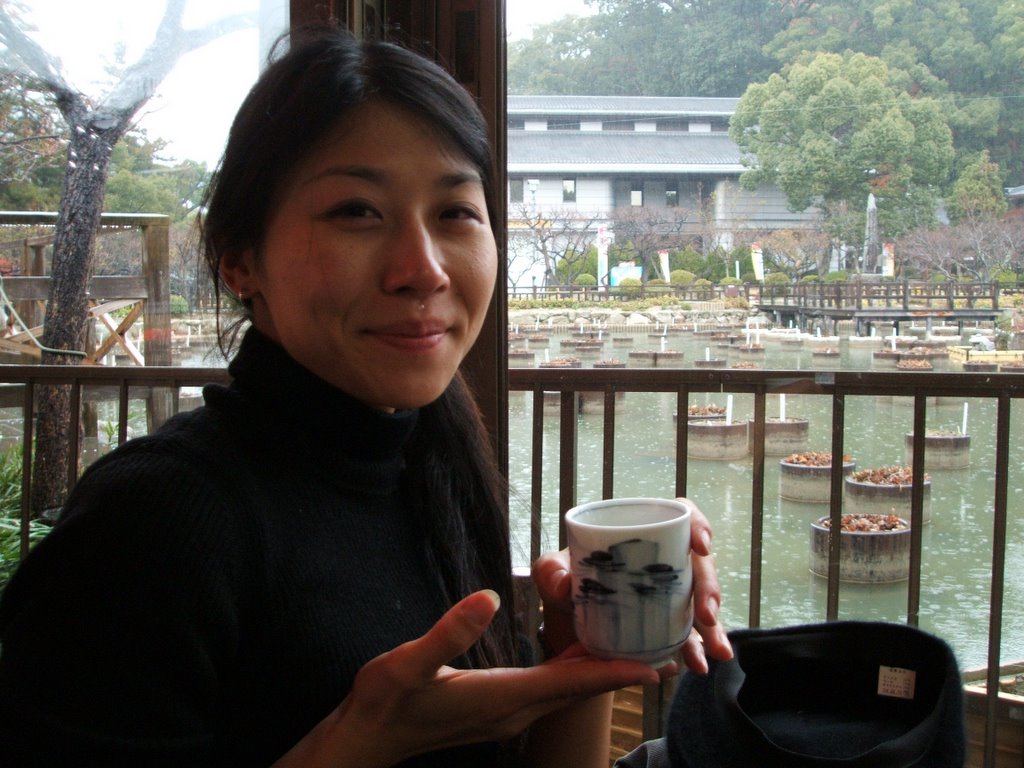
We jumped on the 100 yen bus to the shopping district. From there, we thought about going to Nagasaki but didn’t want to sit on a bus for four hours each way- especially if the weather was going to remain as it was when we got there. Instead, we went took a self directed tour to the Dazaifu Tenmagu shrine, which included a nice hot ceramic cup of macha and a slice of soft mochi- one of my absolute favorite things to eat in Japan.

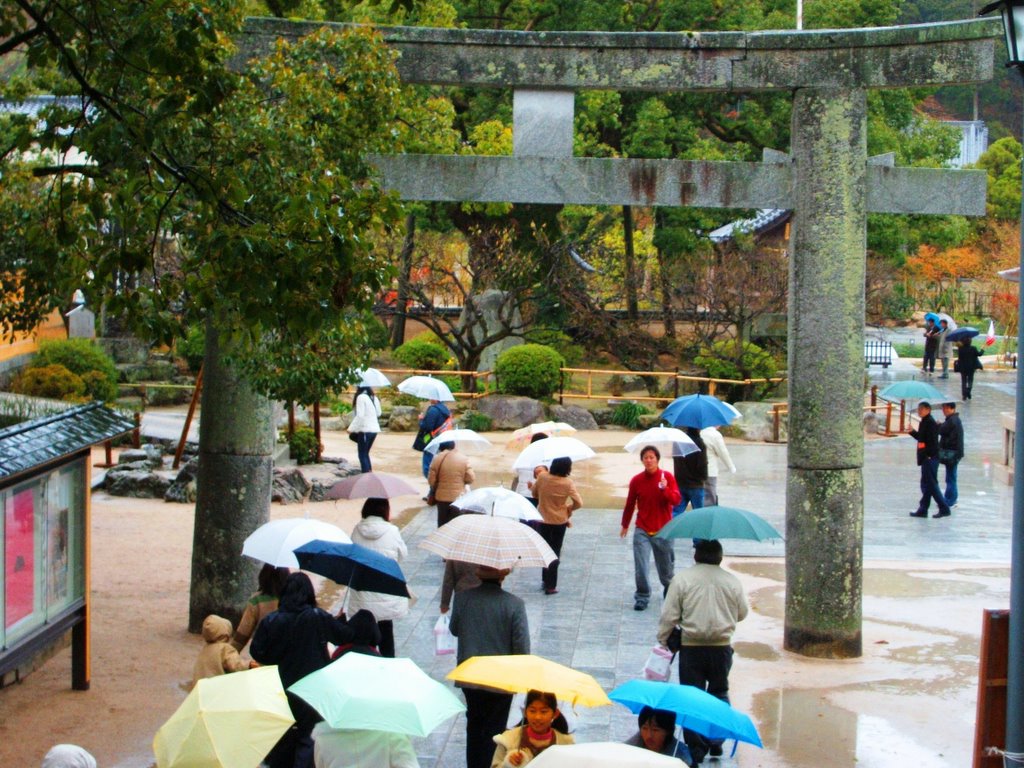
The shrine is located away from the city and due to the weather, had attracted few visitors that day. The pathway of shops leading to the gate was com- prised of all kinds. There were some great art stores, clothing shops, and places to eat. We made our way through, sampling much of what we were offered, and then some. Basically, we were biding our time in hopes that the rain would cease as it did now and then.

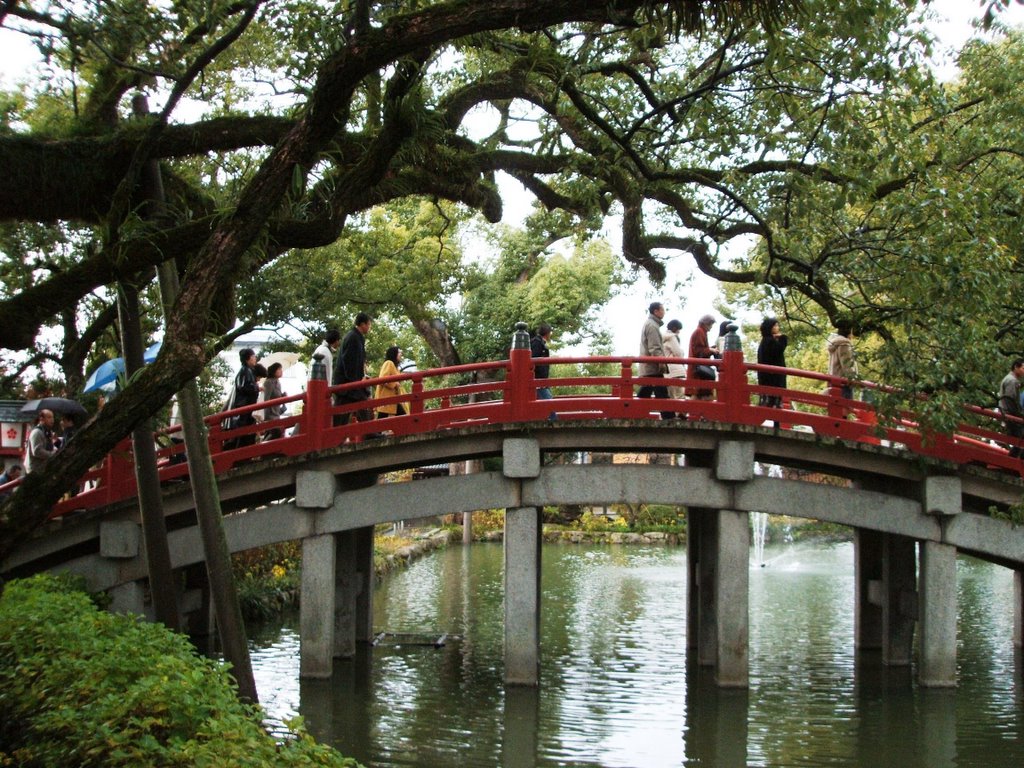
When our chance came, we took it. The rains started again but I had my trusty 500 yen umbrella to shield us. When we reached the main bridge, painted red and arching over the ponds, the sun broke though. What I noticed first was the size of the enormous trees. They were beautifully twisted with centuries of beatings from the rain and wind. Others were huge green monuments, towering above any building in view.

As we made our way around to the back of the shrine, there were some smaller structures on the hillside, sur-
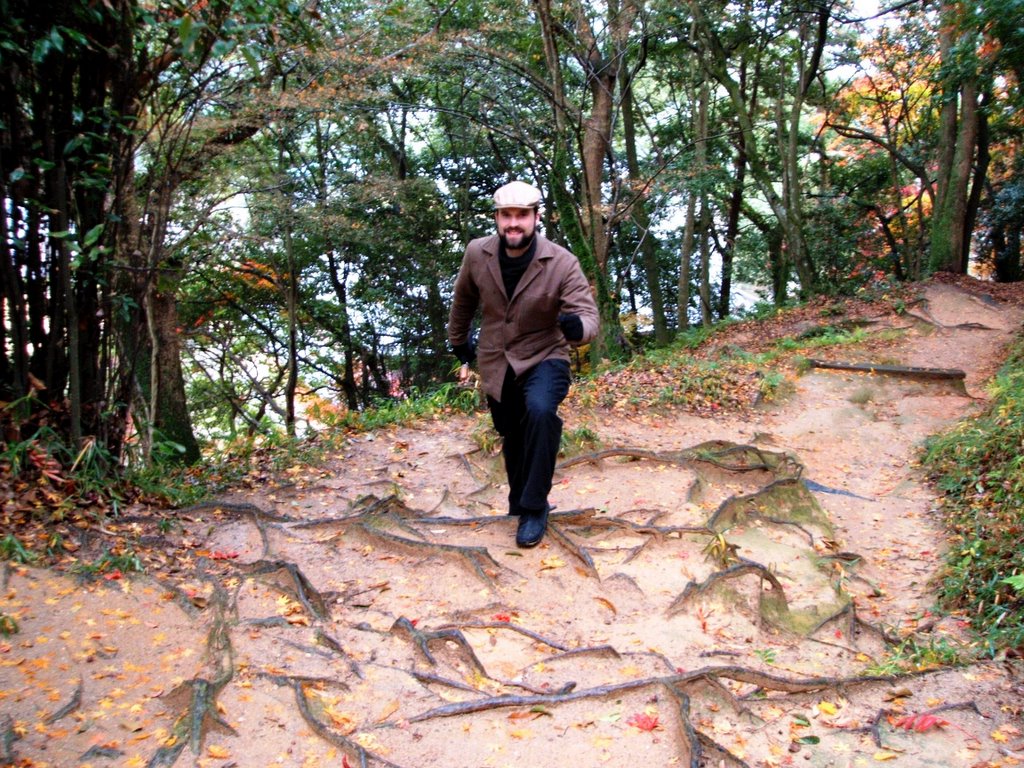
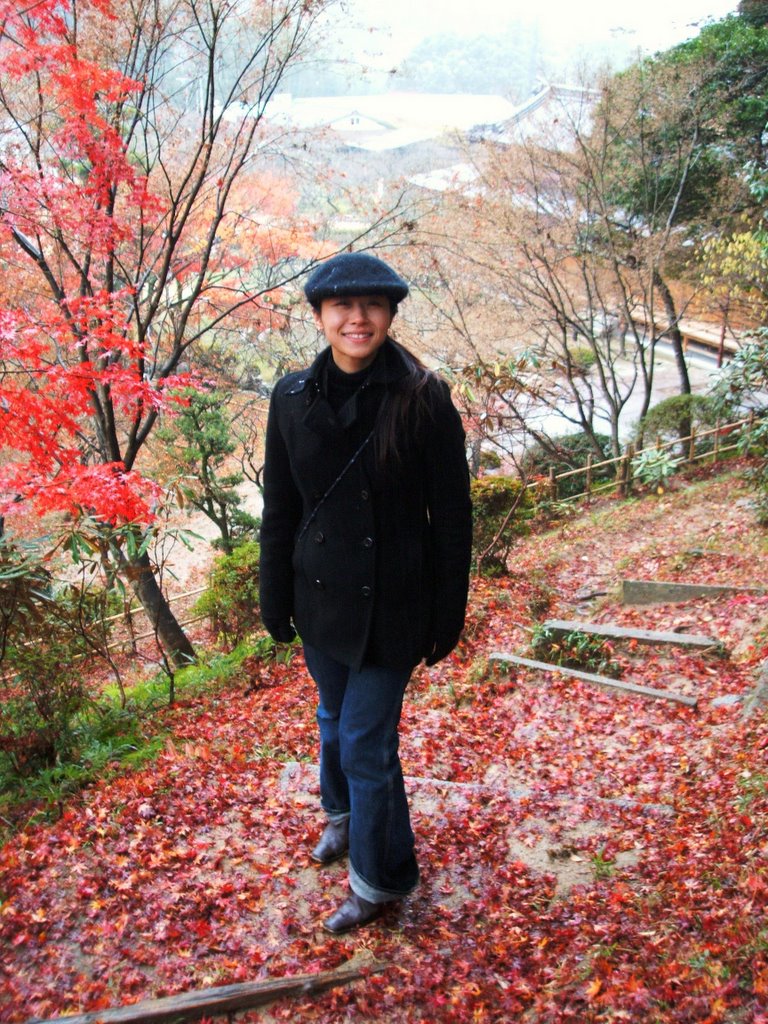
rounded, much to my surprise, with blazing red maples. The trees in the Kansai have all lost their flaring colors. These were among the most spectacular I’ve ever had the pleasure of seeing. We took a short hike through the hills along paths carpeted red maple as if each leaf had been placed with great care.

As we were making our way down the other side, the rains again began to pour. We took shelter in a nice tatami café, set alongside the ponds. By this time, we were really happy that we’d come across it when we did. It was a cozy spot. As we sipped our hot ginger amasake the sun again broke through the clouds and the rains stopped.

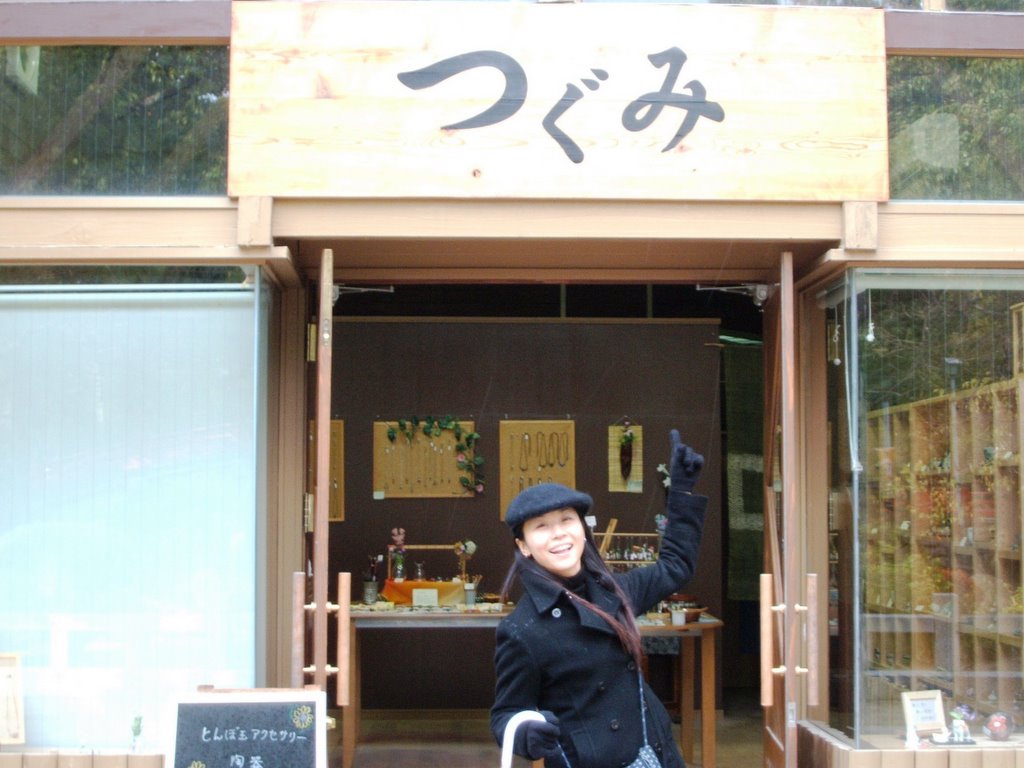
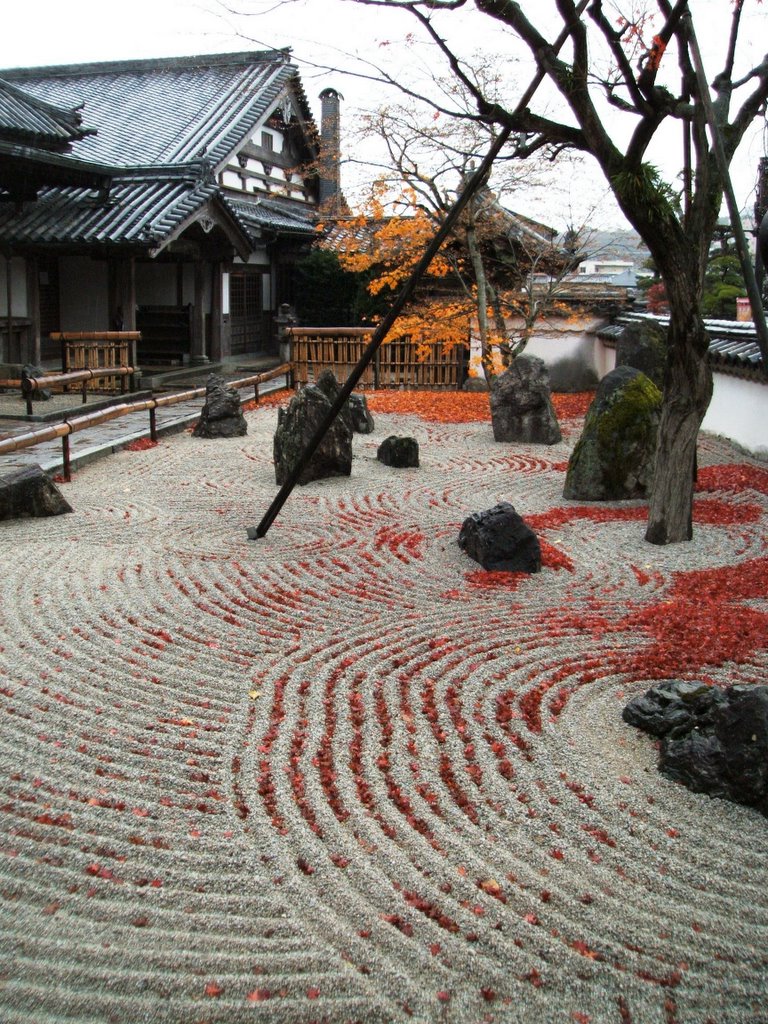
As we were making our way back to the shop lined street, we noticed a place named Tsugumi. It was a quaint home décor shop with many handmade items.We browsed around but didn’t buy anything- quaint and expensive. I love these shops but seldom make a purchase. There was also a Zen temple nearby. I always admire the simplicity of the gardens often surrounding them. Set among the autumn landscape, it made for a very peaceful space.

On the way back through, we ate soba at the same place we had enjoyed the macha and mochi. Unfortunately, the soba was arranged on a plate with a false bottom so what we had hoped would be a nice portion turned into a meager serving. I suppose that’s what we get for eating at the same place twice, something we normally avoid.

That evening, back at the hotel, Tsugumi had made reservations for dinner. We enjoyed a really nice meal together. It was one of those dinners that crown a perfect day. By this time, it felt as though two days had already passed. It was really relaxing. After dinner, Tsugumi gave me my birthday package: a nice black v-neck sweater. We then received a knock at the door; room service served us birthday cake and hand shaken fruit seltzers; a perfect ending to our day.

The next morning we got up and enjoyed a buffet-style breakfast. As my Auntie pointed out, breakfast is the one meal that people from different cultures often cannot agree upon. Japanese breakfasts traditionally consist of rice and miso soup. Being a westerner, I suppose, soup for breakfast is just not appetizing in the least. Fortunately for me, our hotel offered two buffets: one Japanese, one quasi-western. It doesn’t matter all that much in the end because I am usually limited to fruit and bread at breakfast buffets anyway. This one had some potatoes that were pretty tasty. Preferring vegan and vegetarian buffets is extremely difficult to satisfy, regardless of place; that is, if I unless I want a Japanese breakfast.

After we finished up our morning meal, we took a subway to Ohori Koen. At one point this place had been a rather large royal complex, now only the ruins remain and are maintained as a park. At the highest point, there was a platform from which we had a great view. I prayed Asr, then we made our way down
to a lake nearby. The sun was shining but the winds gusts had returned, making for a chilly afternoon. In the center of the lake were a few islands, connected by a series of small bridges. As we walked along the path, the winds were so strong we felt we might be lifted off our feet at any given moment. In the background, someone practiced Jingle Bells on the sax.

We had a while yet, before our flight time. I had read about “Asia’s biggest fairs wheel,” (another pamphlet just said it was the biggest in Japan- who knows?) and wanted to take a ride. It was a jaunt though but we had the timeWhen we arrived, we couldn’t believe the height up this thing; it was BIG! We rushed to the ticket counter but were shut down when we learned that it was closed due to high winds. We decided to do the next best thing: window shop! Okay, not even a close second but we did anyway.

When we finished, we made our way to a bus stop. We had a 15 min wait. About 10 minutes into it, we noticed that the wheel was turning! Yes! But would we have enough time? We decided to take a chance. The next bus came at 17:15, an extra thirty five minutes. We rushed upstairs, back to the wheel. “Two tickets, please,” we asked. “Sorry, it won’t be open until five,” we were told. “Okay, well, how long does it take to go full circle?” we asked. “Twenty minutes.” Damn!! We had probably just missed our bus to get there and take this wheel, thereby risking missing our flight, only to find out that it wasn't to open for another fifteen minutes and that the ride would take twenty; five minutes too long! We broke for the bus. As we barreled down the stairs, we could see passengers boarding 200 meters ahead. Alas! We made it. As we left the wheel in the distance, we could almost hear its deep, sinister laugh, not unlike the marshmallow man from Ghostbusters.

We arrived back at the hotel with plenty of time to make our flight. After checking in our bags, we made our way to the lounge, where we kicked back and relaxed before our departure. It was a great way to begin another year of life. I am looking forward to all it has to bring and I am truly Blessed to have such a wonderful partner in my life to share it with. Al-humdulilah. I must be doing something right. Next phase: Fatherhood- but it’s still a ways off, insha’Allah.